
Remember when LEDs were the future of lighting? Well, buckle up, because the next big thing is already on the horizon.
MicroLED, OLED, and quantum dot technologies are set to surpass traditional LEDs with better energy efficiency, brightness, and color control. These innovations promise to revolutionize everything from home lighting to commercial spaces, offering sustainable and advanced solutions for the future.
Growing up, I always marveled at how a single bulb could transform a room. LEDs were like magic when they first hit the scene, but now we're on the brink of something even more incredible. Technologies like MicroLEDs and OLEDs are not just about saving energy—they’re about creating experiences. Imagine a world where your lighting is as flexible and dynamic as your imagination allows. Whether it’s enhancing your living room ambiance or elevating a commercial space, these innovations promise to make lighting smarter and more sustainable. Let's explore what makes these emerging technologies the future of lighting.
MicroLEDs will fully replace LEDs by 2030.False
MicroLEDs are emerging but unlikely to fully replace LEDs by 2030.
Quantum dots offer better color control than traditional LEDs.True
Quantum dots enhance color precision and brightness over standard LEDs.
How Does MicroLED Compare to Traditional LED Lighting?
Ever found yourself pondering the buzz around MicroLEDs and how they stack up against traditional LEDs?
MicroLED technology outshines traditional LEDs with superior energy efficiency, brightness, and color accuracy, making it ideal for advanced applications, while traditional LEDs remain a cost-effective choice for general use.
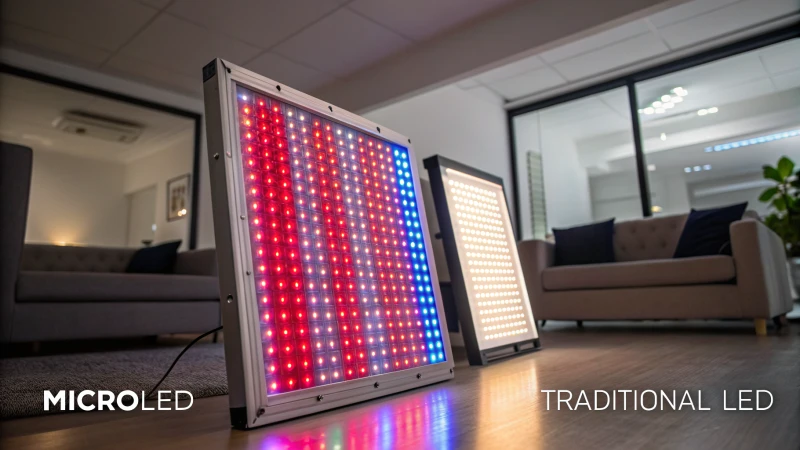
I remember the first time I upgraded my living room lights to LED. It felt like stepping into a new era of brightness and energy savings. But now, with MicroLED entering the scene, I'm drawn to explore its promises of even greater efficiency and color brilliance.
Energy Efficiency and Brightness
Think about the last time you felt a sense of satisfaction from cutting down on your electricity bill. With MicroLEDs, that feeling could be amplified. They use tiny diodes to pump out more light per watt, cutting energy consumption significantly. Imagine watching your favorite show with luminance levels that could light up a stadium—MicroLEDs make that possible without wasting energy.
Color Accuracy and Contrast
Have you ever noticed how some lights just don't capture colors quite right? Traditional LEDs do a decent job for everyday lighting, but MicroLEDs take it up a notch. They deliver vivid colors perfect for high-end displays or spaces where color precision is key. It's like going from a sketch to a high-definition photograph.
| Feature | Traditional LED | MicroLED |
|---|---|---|
| Energy Efficiency | Moderate | High |
| Brightness | Adequate | Superior |
| Color Accuracy | Basic | Advanced |
Longevity and Durability
In my experience, nothing beats the peace of mind knowing your lighting investment will last. MicroLEDs promise longevity thanks to their solid-state design, which withstands wear and tear better than traditional LEDs. Sure, they might cost more upfront, but they pay off in the long run.
Applications and Market Trends
While traditional LEDs are everywhere from your kitchen to office ceilings, MicroLEDs are the rising stars in high-end markets like wearable tech and fancy TV screens. Current market trends1 suggest a shift toward these advanced lights for those seeking top-notch performance.
Future Developments
The potential for MicroLED technology is exciting. Imagine a world where these lights become as affordable as their older counterparts. As production becomes more cost-effective, we might see them illuminate more of our daily lives, bridging the gap between cutting-edge innovation and widespread use.
For anyone like me who loves following the evolution of lighting tech, MicroLEDs open up a world of possibilities that promise to change how we see light—and our world—in more ways than one.
MicroLEDs are more energy efficient than traditional LEDs.True
MicroLEDs use smaller diodes, emitting more light per watt.
Traditional LEDs have better color accuracy than MicroLEDs.False
MicroLEDs provide superior color accuracy due to direct light production.
Can OLEDs Overtake LEDs in Architectural Applications?
Ever wonder if the lights in our buildings could do more than just illuminate? OLEDs might just be the game-changer we've been waiting for.
OLEDs present exciting opportunities for architectural lighting with their design flexibility and vibrant color output. However, their higher costs and shorter lifespan compared to LEDs are significant factors influencing their broader adoption.

Advantages of OLEDs in Architecture
I remember walking into an art gallery and being captivated not just by the artworks, but by the soft, enveloping glow that seemed to emanate from everywhere and nowhere at once. This was my introduction to OLED lighting. Unlike traditional LEDs, OLEDs create a uniform light spread across surfaces, enhancing visual comfort and offering a more natural viewing experience.
- Design Flexibility: Think about those futuristic designs we see in sci-fi movies. OLEDs make them a reality with their ultra-thin and flexible panels that can be integrated into curved surfaces2 and transparent partitions. Imagine lighting that seamlessly merges with furniture or wall panels, something that was mere fantasy with traditional LEDs.
- Superior Color Quality: If you've ever struggled to match paint colors in a dimly lit room, you'll appreciate how OLEDs provide high-quality, natural light that enhances color accuracy. This is crucial in settings like art galleries or retail environments where true color representation matters.
Challenges Facing OLED Adoption
Despite these impressive advantages, I’ve found myself hesitating over OLED installations due to a couple of persistent issues:
| Challenge | OLED | LED |
|---|---|---|
| Cost | Higher production costs | More cost-effective |
| Lifespan | Generally shorter lifespan | Longer lasting |
- Cost Concerns: The first time I considered OLEDs for a project, I was floored by the price tag. The complex manufacturing process means costs are still quite high compared to LEDs. Although prices are on a downward trend, achieving true cost efficiency3 remains a challenge.
- Longevity: In one of my long-term projects, the idea of having to replace OLEDs more frequently than LEDs was a major turnoff. Their shorter lifespan means higher maintenance and replacement costs, which isn’t ideal for projects where budget-consciousness reigns supreme.
Industry Trends and Future Outlook
The lighting industry is buzzing with innovation, and I am eager to see how OLED technology evolves. Manufacturers are investing heavily in research and development to bridge the gap between OLEDs and LEDs.
- Technological Advancements: New materials and techniques are being explored to extend the lifespan and reduce the cost of OLED panels. These advancements promise to make OLEDs more competitive in the long run.
- Market Growth: Projections suggest OLEDs will secure a significant market share by 2030, particularly in sectors where aesthetics outweigh longevity concerns.
In conclusion, while OLEDs offer remarkable potential for specific architectural applications, the decision to adopt them hinges on overcoming current limitations. As technology progresses, I am hopeful that we will see advanced technologies4 reshape how lighting is used in architectural spaces.
OLEDs have a longer lifespan than LEDs.False
OLEDs generally have a shorter lifespan compared to LEDs, affecting adoption.
OLEDs offer superior color quality for architectural lighting.True
OLEDs produce high-quality, natural light beneficial for accurate color representation.
How Do Quantum Dots Transform Future Lighting Solutions?
Imagine lighting that paints your world in vivid colors while saving energy—quantum dots might just make this a reality.
Quantum dots revolutionize future lighting by enhancing color precision and boosting energy efficiency, essential for advanced technologies like LEDs and OLEDs.

Understanding Quantum Dots
I remember the first time I learned about quantum dots. It was like stepping into a science fiction novel where tiny particles could change everything about how we see light. These nanoscale semiconductor particles have an extraordinary ability to emit light at specific wavelengths when hit by light or electricity. It's this magic trick that makes them perfect for boosting color accuracy in lighting solutions.
- Key Properties
- Their nanoscale size means we can control the light emission with incredible precision.
- They are remarkably efficient at converting energy into light, minimizing waste.