
Choosing the wrong street light wastes money and causes project delays. You risk non-compliance and early failures. Let's break down the types to ensure you make the right choice.
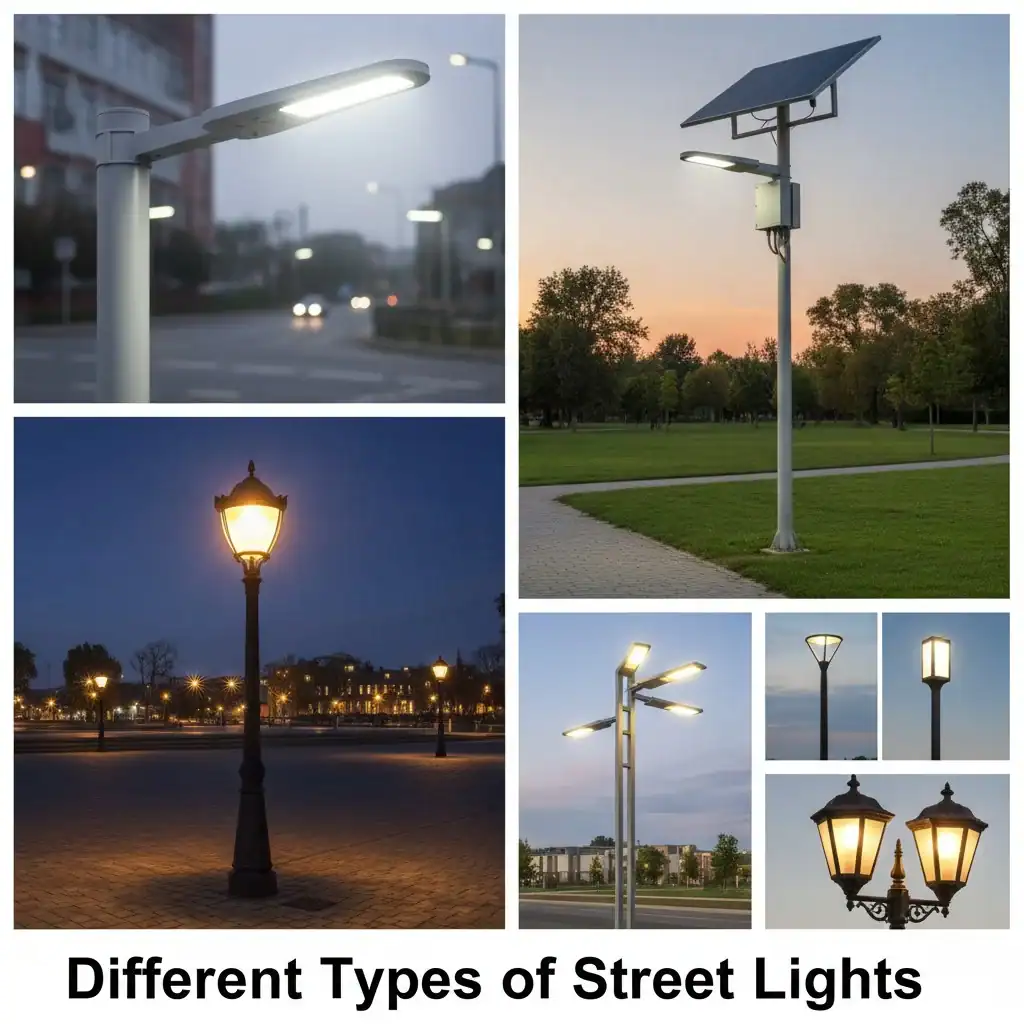
Street lights are categorized by light source (LED, HPS), optics (Type II-V), form factor (cobra head, post-top), and controls (photocell, smart nodes). Each type serves a specific application, ensuring safety and efficiency for different road types.
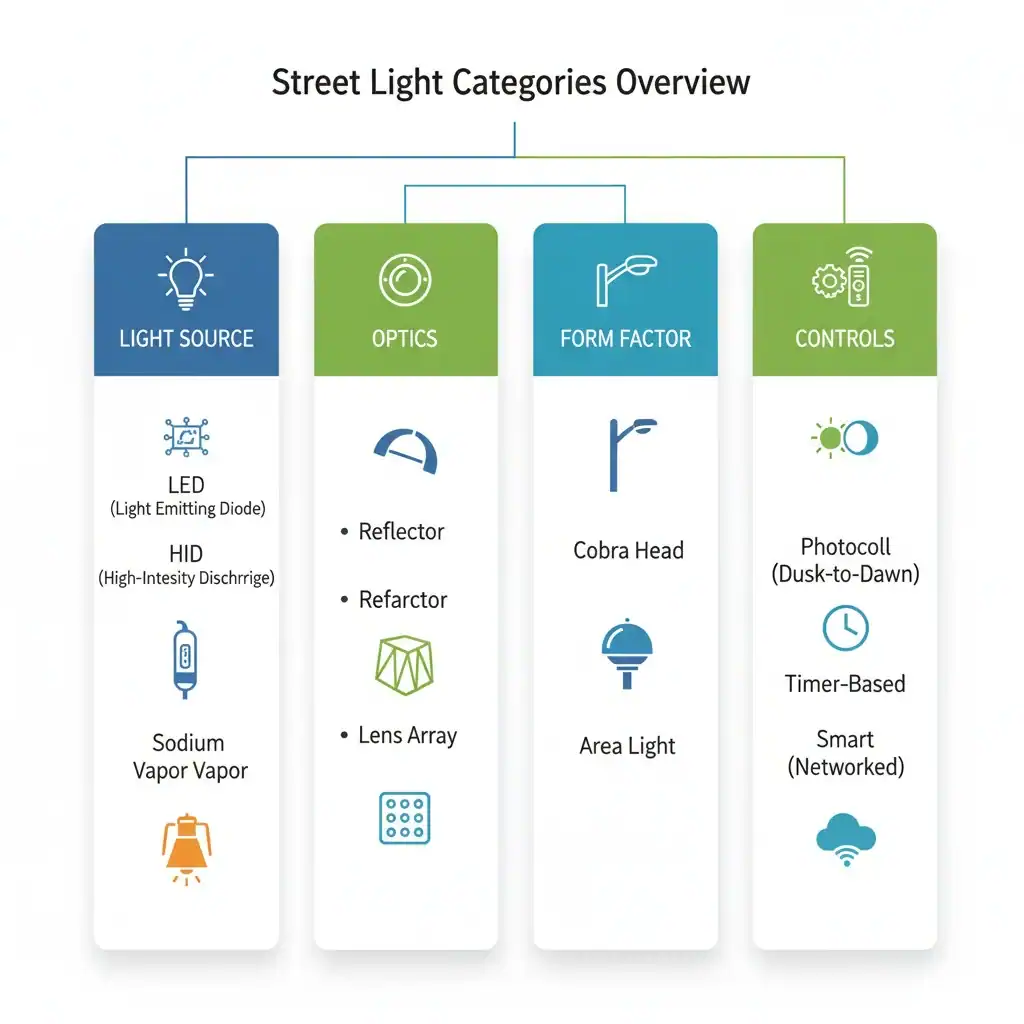
I've seen many distributors like Jose in Mexico get overwhelmed by technical sheets. They focus on watts and price, but the real value is in the details. It's not just about buying a light; it's about investing in a reliable, long-term solution that won't cause headaches later. In my 10+ years running Besenled, I've learned that understanding these differences is key to avoiding costly mistakes. Let's dive into the specifics so you can source with confidence.
LED street lights can reduce energy consumption by up to 80% compared to traditional HPS lights.True
LEDs are far more efficient, converting more electricity into light and less into heat. This efficiency gain is a primary driver for municipal retrofits worldwide.
All street lights with the same wattage produce the same amount of light.False
Luminous efficacy (lumens per watt) varies greatly between technologies and even between different LED models. A high-efficacy 100W LED can be brighter than a low-efficacy 120W LED.
Which light source is best for my project: LED, HPS, or something else?
Using outdated tech like HPS costs you in energy and maintenance. These lights fail often and look dim. Modern LEDs offer better performance, longer life, and lower operational costs.
LED is the dominant choice for new projects due to its high efficiency, long lifespan (50,000+ hours), and excellent color rendering. HPS and metal halide are legacy options, while solar-LED is a specialized solution for off-grid areas.
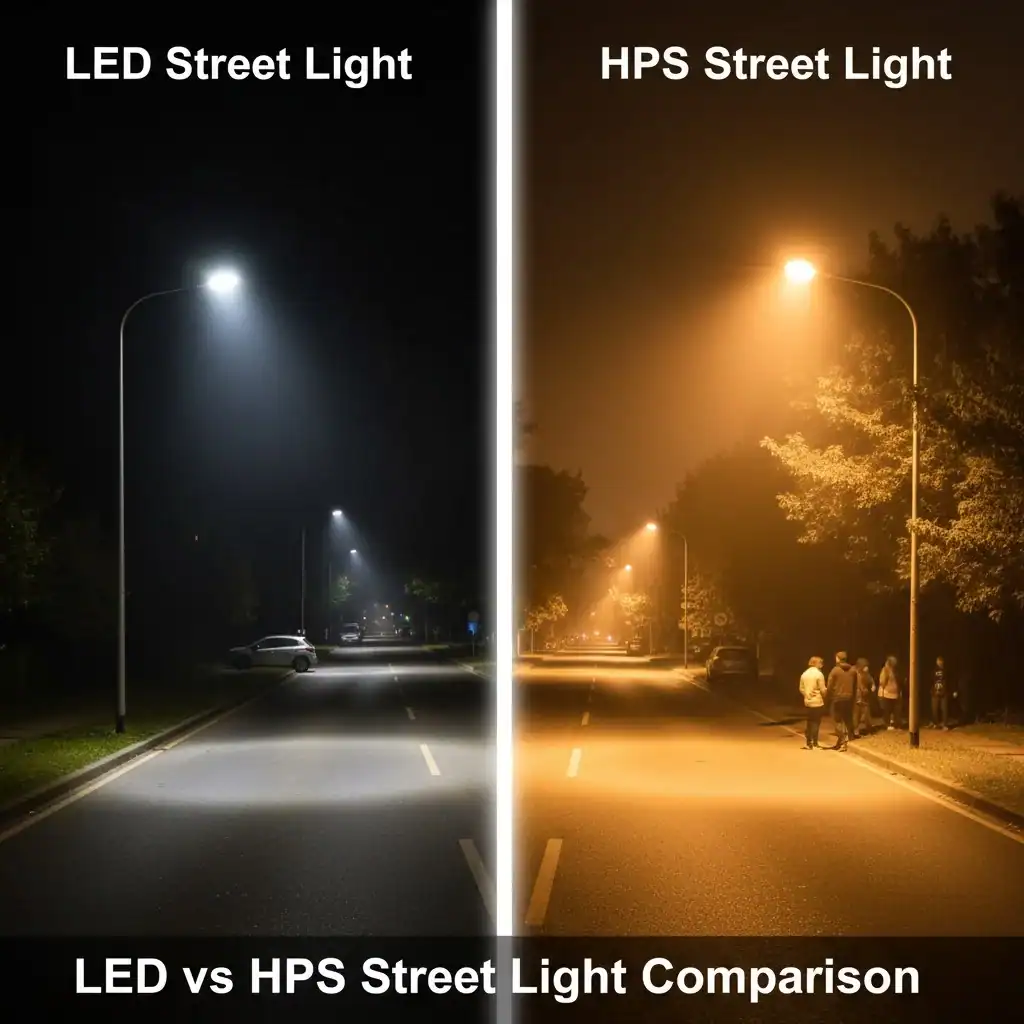
The light source is the engine of your street light. For years, High-Pressure Sodium (HPS) was the standard. It was cheap, but the orange glow had terrible color rendering, and they wasted a lot of energy as heat. Today, the conversation is almost entirely about LED.
Legacy vs. Modern Sources
From my field audits, the LED chips themselves are rarely the point of failure. The real weakness is often the driver or surge protection1. That's why we focus on robust electrical components. Still, understanding the source is step one.
| Light Source | Pros | Cons | Best For |
|---|---|---|---|
| LED | High efficiency, long life, great color, controllable | Higher initial cost than HPS | All new installations and retrofits |
| Solar-LED | No grid connection needed, zero energy cost | High initial cost, battery maintenance | Remote areas, new developments |
| HPS | Low initial purchase price | Poor color, high energy use, short life | Phasing out; legacy replacements only |
| Metal Halide | Better color than HPS | Shorter life than HPS/LED, color shifts over time | Phasing out; some sports lighting |
| Induction | Long life, good efficiency | Bulky, expensive, limited options | Obsolete; surpassed by LED |
The LED Advantage
LEDs are not just a light source; they are a technology platform. They allow for precise optical control, smart dimming schedules, and incredible energy savings. When a client asks for a 150W HPS replacement, I don't just offer a 150W LED. I ask about their project goals. Often, a well-designed 100W or 120W LED with the right optics can do a better job and save them even more money.
Induction lighting is the newest and most efficient street lighting technology.False
Induction lighting was a promising technology in the early 2000s but has been almost completely replaced by the faster-advancing, more efficient, and more versatile LED technology.
Solar-LED street lights operate completely independently of the electrical grid.True
These are standalone systems that generate power from a solar panel and store it in a battery to power the LED luminaire at night, requiring no external wiring.
Which IES optic (II/III/IV/V) should I use for my road width and pole spacing?
Wrong optics create dark spots and waste light, causing non-compliance. This leads to project rejection. The right optic ensures uniform light exactly where it's needed, saving energy.
Use Type II for narrow roads (width < 1.75x mounting height), Type III for medium roads (width < 2.75x MH), and Type IV for wide roads or perimeter lighting. Type V provides a circular distribution, ideal for parking lots.
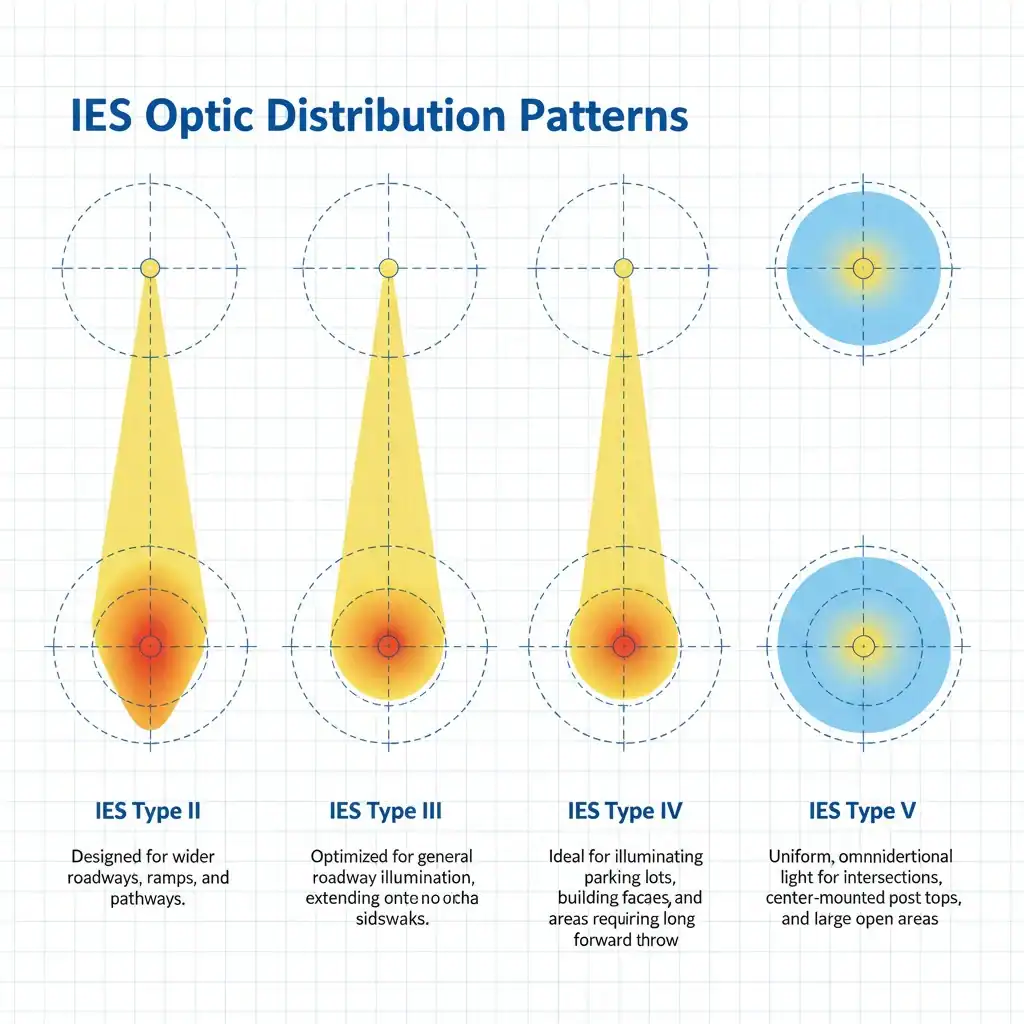
This is where I see distributors make the most expensive mistakes. They focus on wattage, but optic selection is far more critical for meeting project requirements. Choosing the right IES distribution type can reduce energy needs by 10-20% while still hitting illuminance and uniformity targets. An optic is a lens or reflector that shapes the light from the LEDs. Without it, you'd just have a bright light shining down in a circle.
Understanding Light Distribution
The IES (Illuminating Engineering Society) created a classification system to standardize these light patterns. Think of it as a guide to matching the light's shape to the road's shape.
Matching Optics to Your Application
Here’s a simple guide I share with my clients. Assume a standard pole setback from the road.
| Optic Type | Light Pattern | Best Application | Road Width vs. Mounting Height (MH) |
|---|---|---|---|
| Type II | Long and narrow | Narrow roads, pathways | Width ≈ 1.75 x MH |
| Type III | Wider oval | Medium-width roads (e.g., 4 lanes) | Width ≈ 2.75 x MH |
| Type IV | Wide, forward-throw | Wide roads, building perimeters | Pushes light forward away from the pole |
| Type V | Circular | Parking lots, intersections | 360-degree or square pattern |
For any serious project, you must confirm your plan with a lighting simulation using software like DIALux. We provide IES files for all our Besenled products so you or your client can build a virtual model and verify compliance before ordering a single light.
You can use any optic type for any road, as long as the light is bright enough.False
Using the wrong optic wastes light, creates glare, and causes dark spots (poor uniformity), often leading to non-compliance with local lighting ordinances, even if the total lumens are high.
IES files are required to perform professional lighting simulations in software like DIALux.True
An IES file is a standardized photometric data file that describes the intensity of a light source in all directions. This data is essential for software to accurately predict lighting levels and uniformity.
What are the common mounting and form factors for street lights?
Using the wrong form factor looks unprofessional and can be structurally unsafe. It might not fit existing poles. Choosing the right one ensures easy installation and a clean aesthetic.
Cobra head is the most common for roadway lighting, mounted on an arm. Post-top luminaires sit directly on top of decorative poles. High-mast lights are for large areas, and tunnel luminaires are for tunnels.
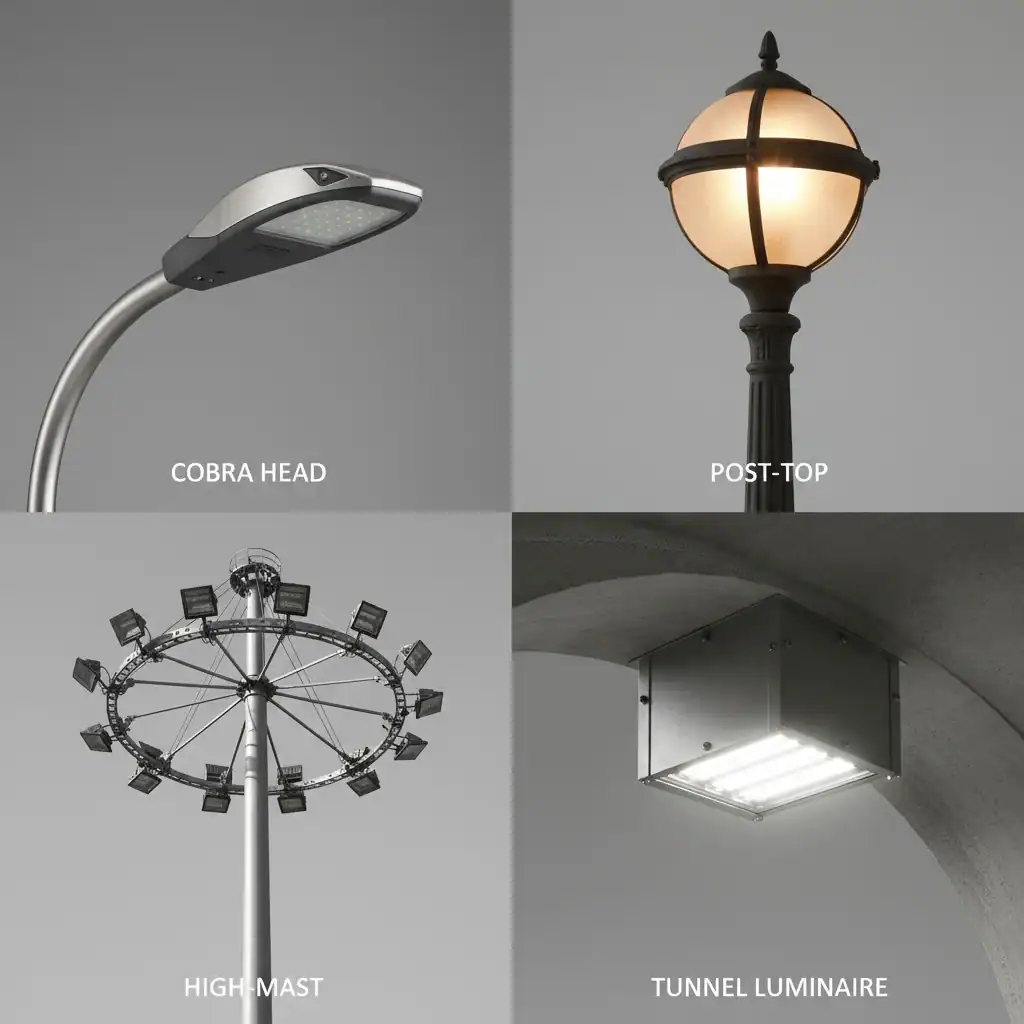
The physical shape and mounting style of a street light—its form factor—is determined by its application. You wouldn't use a decorative park light on a major highway. As a factory, we produce various form factors to meet the diverse needs of our clients, from distributors in South America to contractors in the Middle East.
Roadway and Area Lighting
These are the two most common types you will encounter.
- Cobra Head: This is the classic, most recognizable street light shape. It's designed to be mounted on a mast arm extending over the roadway. Its shape allows for easy access to internal components and effective heat dissipation. It's the workhorse for almost all street and highway lighting.
- Post-Top Luminaire: Also called a decorative or architectural light, this fixture sits directly on top of a pole. It's used in city centers, parks, campuses, and residential areas where aesthetics are as important as performance. They provide a more pleasant, human-scale feel.
Specialized Applications
For more demanding environments, you need specialized designs.
- High-Mast Luminaire: These are powerful floodlights designed to be mounted on very tall poles (20-50 meters). A single high-mast pole can illuminate a massive area like a highway interchange, port, or large industrial yard, reducing pole clutter.
- Tunnel Luminaire: Tunnels are harsh environments with constant vibration, moisture, and corrosive exhaust fumes. These luminaires are typically linear, extremely robust, and built with corrosion-resistant materials to ensure long-term reliability.
A post-top luminaire can be mounted on a highway mast arm.False
Post-top luminaires are designed to be mounted vertically on top of a pole tenon. Cobra head fixtures are designed for horizontal mounting on a mast arm. The mounting hardware is not interchangeable.
High-mast lighting reduces the number of poles needed to light a large area.True
By placing powerful lights on very tall poles (20-50m), a single pole can illuminate an area that would otherwise require dozens of standard-height street light poles, making it ideal for airports, ports, and highway interchanges.
Do I need smart controls for my street lights?
Basic controls waste energy by running lights at full power all night. This increases operational costs. Smart controls allow dimming and monitoring, saving money and improving maintenance.
Start with a simple photocell for dusk-to-dawn operation. For future-proofing, choose luminaires with NEMA or Zhaga sockets. This allows you to easily add smart nodes later for remote control without replacing the fixture.
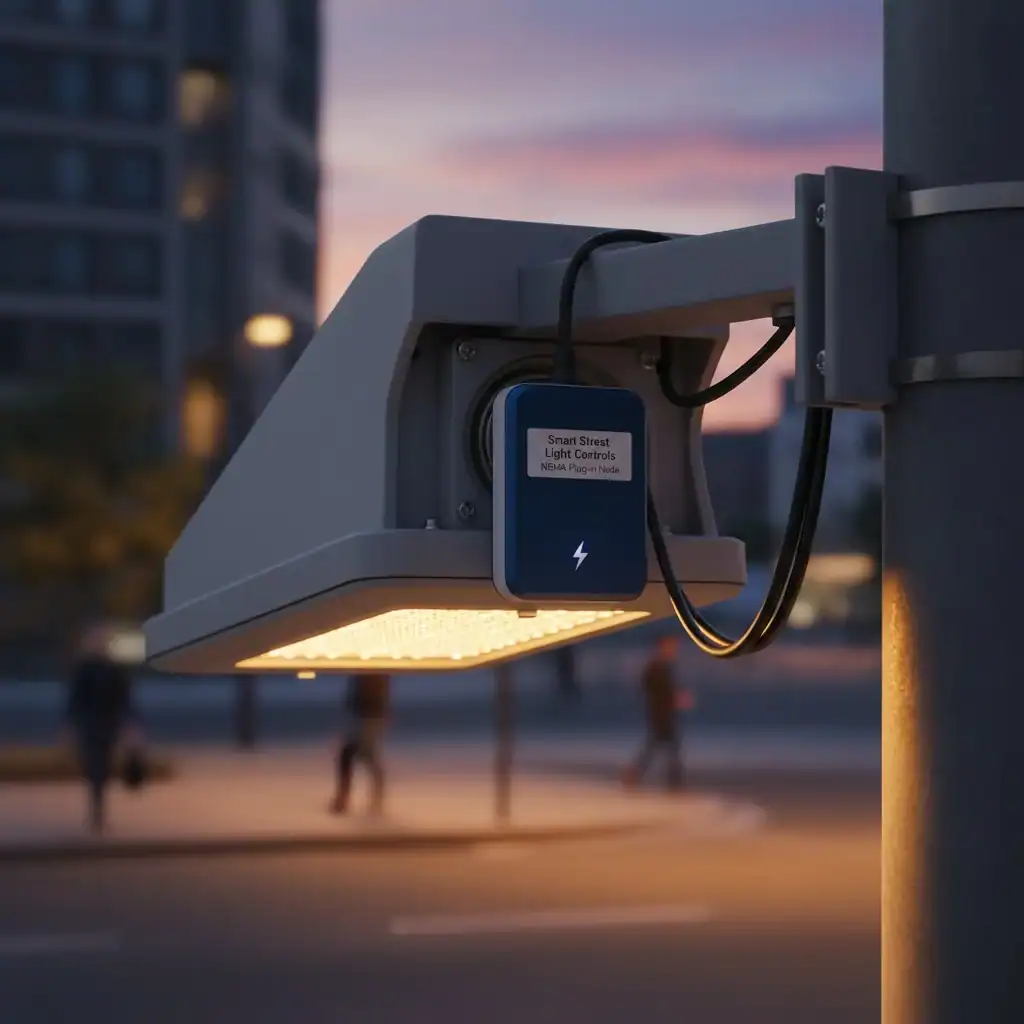
I always advise my clients to think about controls as a long-term strategy. The value of "smart" controls depends entirely on your local electricity tariffs and maintenance needs. For many projects, a simple photocell is enough. But you don't want to strand your asset.
Basic Controls
These are the simplest and most common methods.
- Photocell: A small sensor that detects ambient light. It automatically turns the street light on at dusk and off at dawn. It's reliable and cheap.
- Time Clock: A programmable timer that turns lights on and off at specific times. It's less adaptive than a photocell (e.g., it won't turn on during a dark, stormy day) but can be useful for specific schedules.
Smart-Ready and Smart Controls
This is where future-proofing comes in.
- NEMA/Zhaga Sockets: These are standardized, twist-lock sockets on top of the luminaire. A basic photocell can plug into it. The magic is that you can later unplug the photocell and plug in a "smart node." This is the single most important feature for future-proofing. It makes upgrading cheap and easy.
- CMS/Mesh Network: A Central Management System (CMS) uses smart nodes that communicate (often via a cellular or mesh network) with a central software. This allows a city or facility manager to remotely monitor every light, create custom dimming schedules (e.g., 100% power until midnight, then 50% until 5 am), and receive instant alerts for failures. This is powerful for large-scale operations but overkill for a small parking lot.
My advice? Always specify a NEMA or Zhaga socket. Start with a simple photocell. You can add the smart nodes and CMS later when the budget or need arises.
You must replace the entire street light fixture to add smart controls.False
If the luminaire is equipped with a standard NEMA or Zhaga socket, you can simply unplug the existing photocell and plug in a compatible smart node to add it to a central management system.
Smart controls can save an additional 30-50% in energy costs on top of the savings from converting to LED.True
This additional saving comes from strategic dimming during low-traffic hours and more efficient management, which is not possible with simple on/off controls.
What specs on a datasheet guarantee reliability and compliance?
Ignoring key specs like IP/IK ratings or surge protection leads to early failures. This damages your reputation and increases warranty claims. A simple checklist ensures you buy durable products.
Check for IP65/IP66 for dust/water protection and IK08+ for impact resistance. Demand 10kV/10kV surge protection (SPD). Ensure the driver has a high Power Factor (>0.95) and low Total Harmonic Distortion (<15%).
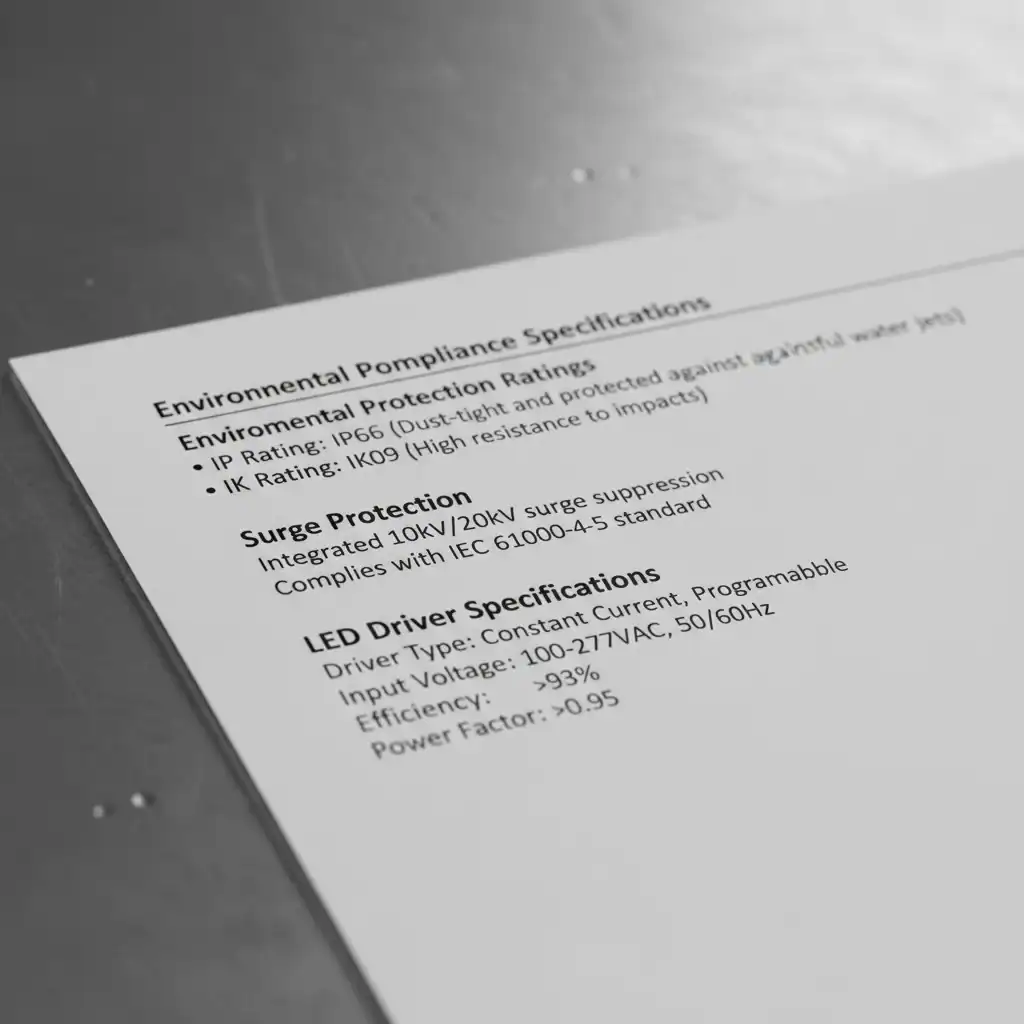
A spec sheet can be confusing, but a few key numbers tell you 90% of the story about a product's durability. After years of analyzing field failures, I can tell you that problems almost always come from electrical issues or water ingress, not the LEDs themselves.
Protection Ratings
These tell you how well the fixture is sealed against the environment.
- IP (Ingress Protection): This is a two-digit number. The first digit is for solids (dust), and the second is for liquids (water). IP66 is the gold standard for street lights. It means the fixture is completely dust-tight and can withstand powerful jets of water.
- IK (Impact Protection): This rates the enclosure's resistance to mechanical impact. IK08 is a good baseline, meaning it can withstand an impact of 5 joules (like a 1.7 kg mass dropped from 300mm).
Electrical Performance
This is where reliability is won or lost.
- Surge Protection (SPD): Lightning strikes and grid fluctuations can kill a luminaire. I recommend a minimum of 10kV/10kV (common mode/differential mode) protection. For areas with harsh grids, like parts of South Asia or Latin America, this is non-negotiable. A good SPD will use an MOV with thermal fusing to safely disconnect if it takes a major hit.
- Driver PF/THD: The Power Factor (PF) should be >0.95, and Total Harmonic Distortion (THD) should be <15%. These specs ensure the light uses electricity efficiently and doesn't pollute the electrical grid, a requirement for many utility companies.
Finally, for hot and humid regions, I always suggest fixtures with sealed optics and a "breather" vent. This prevents moisture from getting inside the lens during temperature changes, which can cause a hazy fog and reduce light output over time.
A street light with an IP65 rating is fully waterproof and can be submerged.False
IP65 means the fixture is protected against jets of water from any direction, but it is not rated for submersion. Submersible fixtures require an IP67 or IP68 rating.
High Total Harmonic Distortion (THD) can cause overheating in a building's wiring and interfere with other electronic equipment.True
THD represents 'dirty' power returned to the grid. High levels can disrupt the electrical network, which is why many utilities have strict limits for connected devices like street lights.
When should I choose solar street lights over grid-tied ones?
Trenching for grid power is expensive and sometimes impossible. This can kill a project budget. Standalone solar lights offer a solution where the grid is unavailable or too costly to access.
Choose solar street lights2 for remote areas, new developments without existing infrastructure, or locations where trenching costs are prohibitive. They are ideal for parks, rural roads, and security lighting.
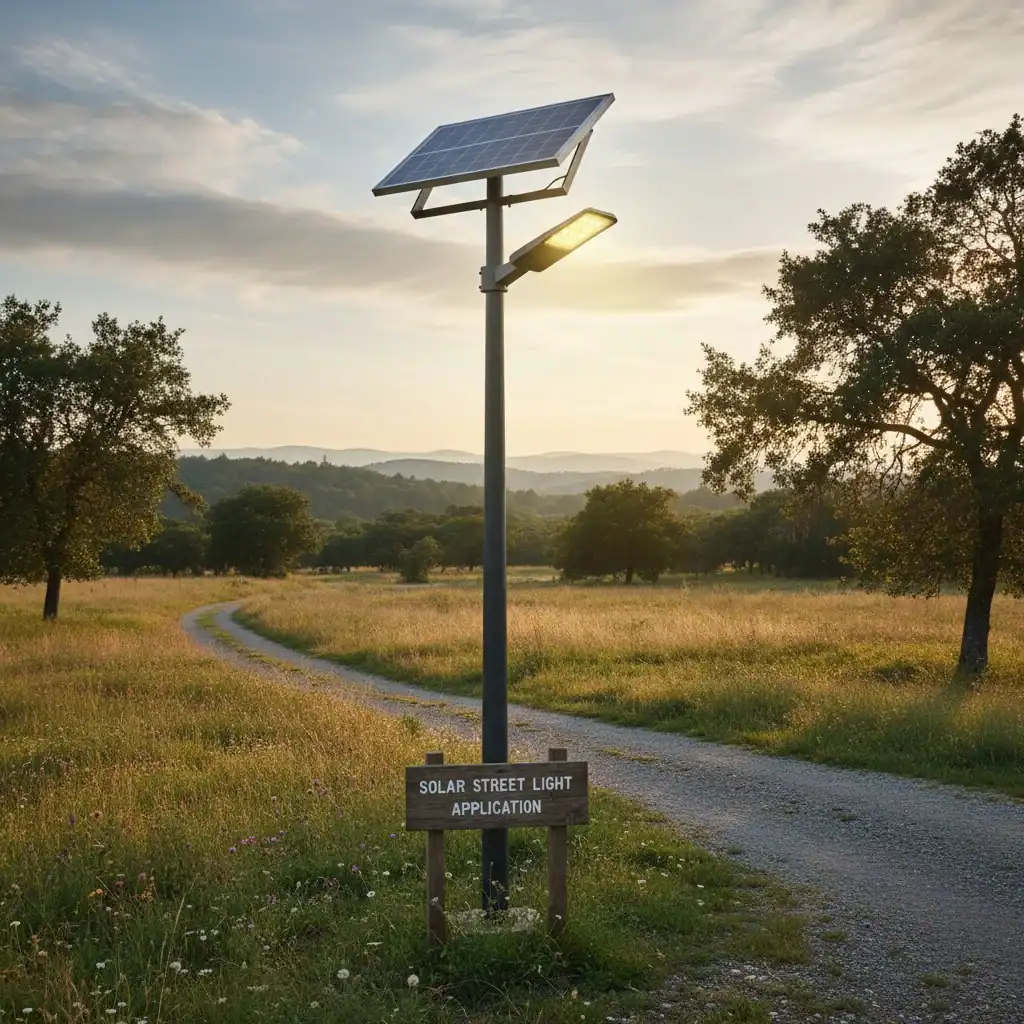
As a manufacturer of both traditional and solar lights, I get this question a lot. The decision is almost always a financial one. A solar street light has a higher upfront cost than a grid-tied one. But the grid-tied light has a hidden cost: getting power to the pole.
The Business Case for Solar
The real value of solar shines when you factor in installation costs.
- Cost Analysis: Trenching cable, running conduit, and connecting to the grid can cost thousands of dollars per pole. If your project involves lighting a new rural road or a remote parking area, the cost of trenching can easily exceed the cost of the luminaires themselves. In these cases, a standalone solar light is cheaper overall.
- Applications:
- Rural roads or villages with no grid access.
- Parks, trails, and bikeways.
- New real estate developments before the grid is fully installed.
- Security lighting for remote industrial sites or farms.
Key Considerations for Solar
If you go with solar, you must size the system correctly.
- System Sizing: A reliable solar light is a balanced system. The solar panel wattage and battery capacity must be calculated based on the project's location (how many hours of sun it gets per day) and the required autonomy (how many cloudy days the light needs to run without recharging). A system sized for Mexico will not work in Northern Europe.
- Maintenance: The main maintenance item is the battery, which typically needs replacement every 3-5 years for LiFePO4 models. The solar panel also needs to be cleaned periodically to ensure it's generating maximum power.
A single solar street light model can be used anywhere in the world.False
Solar lighting systems must be sized specifically for their geographic location. A system designed for a sunny climate will fail in a region with fewer sun hours and longer winter nights.
The cost of trenching and wiring for a single grid-powered street light can sometimes exceed the cost of a complete standalone solar street light.True
In remote locations or areas with difficult terrain, civil works costs for grid connection can be extremely high, making solar a more economical choice from day one.
How do I create a tender-ready specification sheet?
Vague specifications lead to low-quality bids and products that don't perform. This wastes time and money. A clear, detailed spec sheet ensures you get exactly what you need.
Your spec sheet must include lumen package3 (e.g., 15,000 lm), CCT (e.g., 4000K), and minimum CRI (e.g., >70). Always request the IES file for lighting simulations and TM-30 reports for color quality.
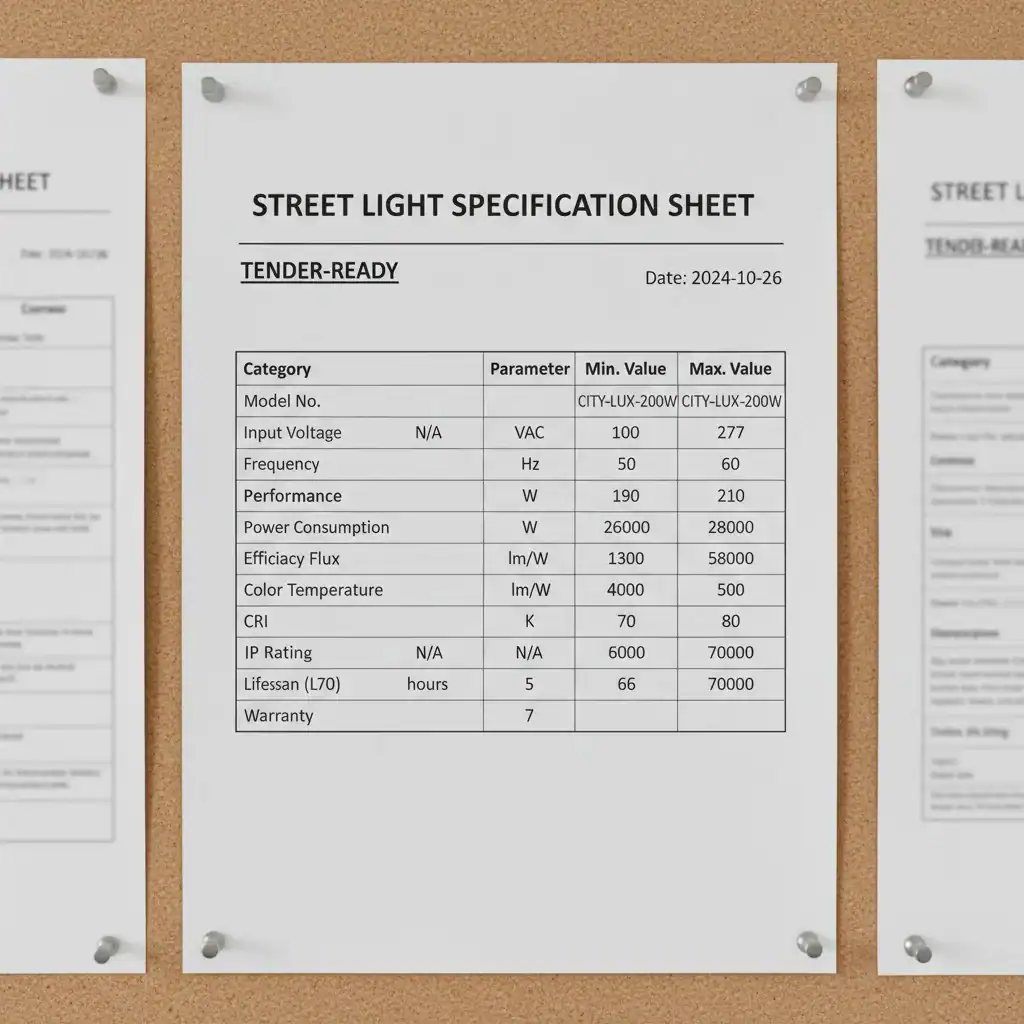
When you send a request for quotation (RFQ) to a factory like mine, the quality of your specification sheet determines the quality of the product you will get. A vague request like "100W LED street light" will get you a wide range of prices and quality levels. A detailed spec sheet ensures every supplier is bidding on the exact same performance criteria.
Essential Photometric Data
This describes the light itself.
- Lumen Package: Specify the total light output required in lumens (e.g., 12,000 lm), not just the wattage. This focuses on performance, not power consumption.
- CCT (Correlated Color Temperature): This is the color of the light, measured in Kelvin. 3000K is a warm white, 4000K is a neutral white (most common for roads), and 5000K is a cool white.
- CRI / TM-30: Color Rendering Index (CRI) measures how accurately the light shows colors. CRI >70 is standard for roads. For areas where color is more important, like commercial districts, specify CRI >80. TM-30 is a newer, more comprehensive metric that gives a fuller picture of color rendition.
The Importance of IES Files
This is a non-negotiable request for any professional project.
- IES File: An IES file is a digital text file that describes the unique light distribution pattern of a specific luminaire. Without it, you cannot perform a lighting simulation in software like DIALux to verify that your lighting plan will meet the required illuminance and uniformity levels. I always tell my clients: if a supplier cannot provide an IES file, they are not a serious professional manufacturer. We provide them for every product we make.
Specifying wattage is the best way to ensure you get the right amount of light.False
Specifying the required lumen output is better. A high-efficiency 80W LED can be brighter than a low-efficiency 100W LED, so focusing on lumens ensures you get the performance you need.
TM-30 is a more modern and comprehensive color rendering metric than CRI.True
While CRI uses only 8 color samples, TM-30 uses 99. It also provides fidelity and gamut information, giving a much more detailed and accurate picture of how a light source will render colors.
How do I balance cost and reliability when sourcing street lights?
Choosing the cheapest option often leads to early failures and high maintenance costs. This hurts your brand's reputation. Focusing on key reliability components provides the best long-term value.
Don't just look at the price. Invest in a robust SPD (10-20kV), a reputable driver brand, and good thermal management4. Check the ambient temperature rating to ensure it suits your climate.
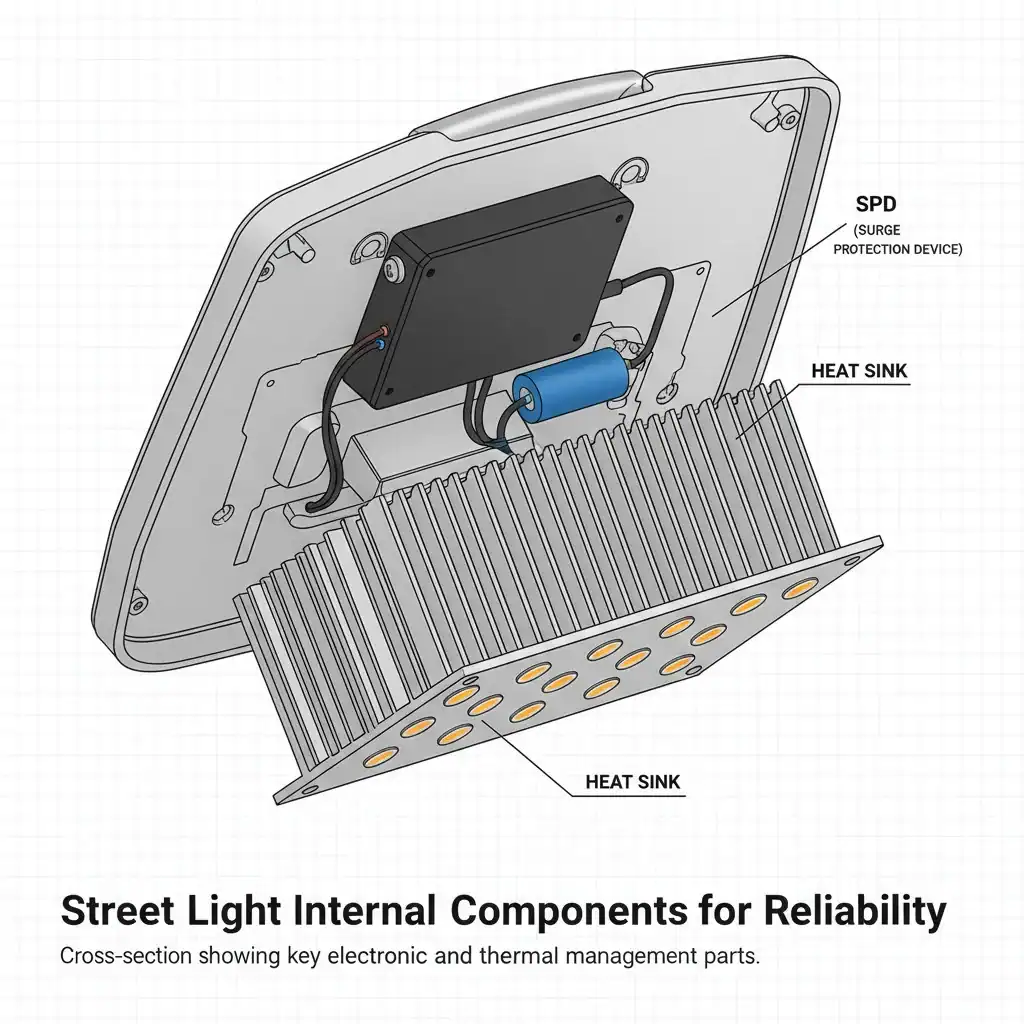
Every distributor, especially a business owner like Jose, has to balance cost and quality. The cheapest price is tempting, but I've seen it lead to disaster. A failed street light isn't just a warranty claim; it's a loss of reputation. The secret is to know where to spend your money. From my experience, most failures trace back to two things: the driver and the surge protection.
Where to Spend Your Money
These components are the heart and shield of your luminaire.
- SPD (Surge Protection Device) Design: Don't just accept "10kV SPD." Ask for details. A good design uses a combination of Metal Oxide Varistors (MOVs) and a thermal fuse. This means it can take multiple smaller hits and will safely disconnect itself after a catastrophic surge, protecting the rest of the light. I always recommend a minimum of 10kV, and 20kV for high-risk areas.
- Driver Brand: The driver is the power supply for the LEDs. It's the component most likely to fail. Using a reputable, globally recognized brand like Mean Well or Inventronics costs a little more but dramatically reduces failure rates.
- Thermal Path: Heat is the enemy of LEDs. A good design has a direct, efficient thermal path from the LED board to a heavy, well-designed heat sink. A light that feels solid and heavy is often a good sign of proper thermal management.
What to Look For
- Ambient Ratings (Ta): Check the maximum ambient temperature rating (Ta). A fixture rated for Ta=45°C might fail prematurely in a Middle Eastern country where summer temperatures exceed 50°C.
- Warranty Details: Look beyond the number of years. Does the warranty cover labor? What is the process? A good warranty from a reliable partner like Besenled is a sign of confidence in the product's reliability.
The brand of the LED driver does not affect the reliability of a street light.False
The driver is one of the most common points of failure. Reputable brands like Mean Well or Inventronics use higher-quality components and have more robust designs, leading to significantly longer lifespans and lower failure rates.
A heavier street light is always better quality.False
While weight can indicate a substantial heat sink, it can also just mean an inefficient design or use of low-grade materials. Quality is determined by the design of the thermal path and the quality of components, not just weight.
Your Top Questions About Street Lights Answered?
You have questions, but finding clear answers is hard. This uncertainty can delay decisions. Here are direct answers to the most common questions I hear from distributors.
The main types are based on light source, optics, and controls. Optic choice depends on road width. Smart controls are optional but future-proof. Reliability comes from good drivers and surge protection. Choose solar for off-grid locations.
After more than 10 years in this business, I've heard every question imaginable. Many distributors I speak with, from North America to Central Asia, often have the same core concerns. Let's get you some quick, clear answers based on what we've discussed.
What are the main street light types?
The main types are categorized by four things:
- Light Source: Primarily LED and Solar-LED today.
- Optics: IES Types like II, III, IV, and V that shape the light for different roads.
- Form Factor: The physical shape, like a cobra head for roads or a post-top for parks.
- Controls: From simple photocells to smart CMS networks.
Which optic suits my roadway?
It depends on the ratio of road width to the pole's mounting height. As a general rule: use Type II for narrow roads, Type III for medium-width roads, and Type IV for very wide roads or perimeters. Type V is for large, open areas like parking lots. Always confirm with a lighting plan.
Do I need smart controls?
Not necessarily. For most projects, a simple photocell is sufficient and cost-effective. However, I strongly recommend buying luminaires with a NEMA or Zhaga socket. This makes your project "smart-ready," so you can easily upgrade to smart controls in the future without replacing the whole fixture.
What specs ensure reliability?
Focus on the specs that prevent the most common failures. Insist on an IP66 rating for water/dust proofing, an IK08 rating for impact, and robust 10kV/10kV surge protection. Most importantly, specify a high-quality driver from a reputable brand and check that the fixture has a good thermal design.
When to choose solar?
Choose solar when the cost of connecting to the electrical grid is too high or impossible. This is common for rural roads, large parks, new developments, and remote industrial sites. The higher upfront cost of the solar fixture is often much less than the cost of trenching and wiring.
A NEMA socket is only for photocells.False
While commonly used for photocells, the standardized NEMA socket is designed to accept a variety of devices, including shorting caps, photocells, and advanced smart control nodes.
A street light's reliability is primarily determined by the quality of its LED chips.False
While LED chip quality is important for light output and longevity, most field failures are caused by the failure of the electronic driver or damage from electrical surges, making the driver and SPD more critical for overall reliability.
Conclusion
Choosing the right street light means looking beyond price. Focus on optics, reliability specs, and controls to ensure a successful project and protect your reputation.
References
Surge protection is vital for preventing damage from electrical surges, ensuring the longevity of street lighting systems. ↩
Solar street lights offer a sustainable solution for areas without grid access, making them ideal for remote locations. ↩
Understanding lumen packages helps in selecting the right brightness for street lights, ensuring adequate illumination. ↩
Effective thermal management extends the lifespan of LED street lights by preventing overheating, ensuring consistent performance.