

Do you ever think about changing your room with just the right light? I want to tell you a bit about my path into the world of TRIAC dimmers.
TRIAC dimmers are electronic devices. They adjust light brightness by controlling power flow. These dimmers work by cutting off parts of the AC waveform. They are ideal for incandescent and some LED lights. Understanding how they work is important. Knowing their benefits and installation really helps. This knowledge allows people to choose wisely.
I remember the first time I put in a dimmer switch in my home. It changed the mood in the room completely. Suddenly, my living room felt warm and welcoming. I chose TRIAC dimmers. They let me adjust the mood just right. These devices control how the power flows. They are perfect for incandescent bulbs and many LED lights. As I learned more, I discovered more about their operation. Knowing their benefits really changed how I think about lighting. Understanding how to install them too. Let's explore this guide! It shares tips and tricks to really improve your lighting choices.
TRIAC dimmers are suitable for both incandescent and LED lights.True
TRIAC dimmers effectively control brightness in incandescent and certain LED lights by managing power flow.
TRIAC dimmers can improve energy efficiency in lighting systems.True
By adjusting brightness levels, TRIAC dimmers help reduce energy consumption, enhancing overall efficiency.
How Do TRIAC Dimmers Work?
Have you ever thought about how TRIAC dimmers function? These devices are really interesting. Understanding how they work probably increases your interest. It also helps you enjoy better lighting control and save energy.
TRIAC dimmers use a TRIAC semiconductor to manage power flow. They change brightness through phase-cutting techniques. These techniques include leading or trailing edge. This process helps save energy in lighting systems. Their design fits different light sources. They are a very popular choice.
%[Technical diagram of a TRIAC dimmer circuit]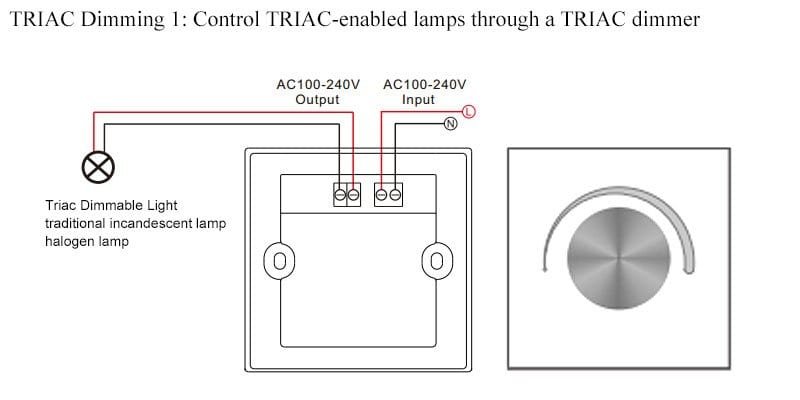
The Basics of TRIAC Dimming
TRIAC dimmers utilize a semiconductor device known as a TRIAC (Triode for Alternating Current) to control the power supplied to lighting fixtures. When the TRIAC is triggered, it allows current to flow through the circuit, adjusting the voltage and thus the brightness of the light. This method is efficient because it reduces the total energy consumption by altering the waveform of the AC signal.
How TRIACs Control Brightness
The operation of TRIAC dimmers is based on phase-cutting techniques. In this process, the TRIAC cuts off a portion of each AC cycle, which effectively reduces the amount of power delivered to the light source. There are two main types of phase cutting:
Leading Edge Dimming: This method turns on the TRIAC early in the AC cycle, leading to a soft start of the lamp. It's compatible with most incandescent and halogen lights.
Trailing Edge Dimming: This approach turns on the TRIAC later in the cycle and is smoother, making it ideal for LED and low-voltage lighting. It minimizes flicker and noise while offering better compatibility with modern lighting technologies.
Components of a TRIAC Dimmer
Understanding the components of a TRIAC dimmer can help clarify how they work:
| Component | Function |
|---|---|
| TRIAC | Acts as a switch that controls current flow. |
| Diac | Provides a trigger signal for the TRIAC. |
| Potentiometer | Adjusts the delay of the TRIAC trigger. |
| Capacitor | Smoothens out voltage fluctuations. |
Advantages of TRIAC Dimmers
TRIAC dimmers are favored for several reasons:
- Compatibility: They work well with traditional incandescent bulbs and many LED lights.
- Efficiency: They provide significant energy savings by reducing power consumption.
- Cost-Effective: Generally more affordable than other dimming technologies.
For more detailed information, check out TRIAC dimming technology1 or explore different types of dimmers2.
TRIAC dimmers only work with incandescent bulbs.False
This claim is false as TRIAC dimmers are compatible with both incandescent and many LED lights.
Leading edge dimming provides a soft start for lamps.True
This claim is true; leading edge dimming turns on the TRIAC early, ensuring a gradual increase in brightness.
What Are the Advantages and Disadvantages of TRIAC Dimmers?
Ever stood in a dim room, adjusting the lights to get the right atmosphere? TRIAC dimmers help with this! Before starting your next lighting project, let's discover the good and bad sides of these devices together. It's probably interesting!
TRIAC dimmers are affordable and easy to install. They sometimes have problems working with LED bulbs. They also create heat. Knowing these points really helps to control lighting well.

Advantages of TRIAC Dimmers
TRIAC (Triode for Alternating Current) dimmers are popular in lighting control due to several key advantages:
Cost-Effective:
TRIAC dimmers are usually cheaper than other options. This is great for big projects where saving money matters. I remember those times when cheap solutions were very important for my work.Simplicity and Compatibility:
TRIAC dimmers fit with traditional incandescent and halogen bulbs, like shoes that match every outfit. They easily blend into existing systems.Ease of Installation:
Installing a TRIAC dimmer is simple. The first time I did it, I was amazed how quick and easy it felt. Simple connections save time and reduce labor costs in commercial jobs.Widespread Availability:
Finding these dimmers is easy. Many manufacturers sell them, so you can probably find one that suits your needs without much trouble.Reliable Performance:
These dimmers work well with compatible bulbs, providing no annoying flickers or buzzing. My clients often praise the pleasant lighting when using these dimmers.
Disadvantages of TRIAC Dimmers
While TRIAC dimmers offer several benefits, there are also notable drawbacks:
Compatibility Issues with LEDs:
Not all LED bulbs work well with TRIAC dimmers, which can cause flickering or poor dimming. Clients sometimes panic when their new LEDs do not cooperate.Limited Dimming Range:
TRIAC dimmers often limit how much you can dim lights, restricting creative lighting control.Heat Generation:
TRIAC dimmers can get warm, especially with high-wattage bulbs increasing heat during operation. Adequate heat management is key for longer-lasting dimmers.Non-Linear Dimming:
Sometimes, TRIAC dimmers change brightness unexpectedly; this unpredictability might not match your lighting plans precisely.Potential for EMI:
Electromagnetic interference (EMI) may happen, especially in sensitive places like offices or hospitals; consider this when planning your lighting setup.
Summary Table of Advantages and Disadvantages
| Advantages | Disadvantages |
|---|---|
| Cost-effective | Compatibility issues with LEDs |
| Simplicity and compatibility | Limited dimming range |
| Ease of installation | Heat generation |
| Widespread availability | Non-linear dimming |
| Reliable performance | Potential for EMI |
Understanding these advantages and disadvantages can assist in making informed decisions regarding the implementation of TRIAC dimmers in lighting systems. For further insights on installation tips and troubleshooting, check out more information here3. Lighting creates an experience, not just visibility!
TRIAC dimmers are cost-effective for large installations.True
Due to their lower price compared to other dimming technologies, TRIAC dimmers help save money on extensive lighting projects.
All LED bulbs work perfectly with TRIAC dimmers.False
Many LED bulbs are incompatible with TRIAC dimmers, often causing flickering or improper dimming performance.
Which Lighting Types Are Compatible with TRIAC Dimmers?
Setting the perfect mood in your space depends on lighting compatibility with TRIAC dimmers. But which types truly suit this need? Let's explore together!
TRIAC dimmers usually work with incandescent and halogen bulbs. LED and CFL bulbs may not always fit. Really important to check if LED and CFL bulbs are marked as dimmable. This helps stop flickering problems.

Understanding TRIAC Dimmers
TRIAC dimmers are popular for their ability to control the brightness of various lighting types, but not all bulbs are compatible. Understanding which lights work with these dimmers is crucial for optimal performance and safety.
Incandescent Bulbs
Classic incandescent bulbs work well with TRIAC dimmers. They react nicely to voltage changes, allowing smooth dimming.- Advantages:
- Full range of dimming
- Warm light creates inviting spaces
- Disadvantages:
- Not energy-efficient, which becomes costly over time.
- Advantages:
Halogen Bulbs
Halogen bulbs resemble incandescent bulbs but use energy more wisely. They shine bright and save more power. I once used them to highlight art pieces. The colors popped!- Advantages:
- More energy-efficient than regular incandescents
- Bright white light reveals details
- Disadvantages:
- Still uses more energy than LEDs, so consider that.
- Advantages:
LED Bulbs
LEDs have changed lighting dramatically! Yet, TRIAC dimmer compatibility varies. I once installed an LED, hoping for perfection, but it flickered like a horror film audition. Check compatibility ratings.- Advantages:
- Saves plenty of energy, which is a treat for the wallet!
- Long lifespan reduces hassle over time.
- Disadvantages:
- Risk of flickering if the bulb isn’t compatible.
Consider looking into dimmable LED options4 to ensure optimal performance with TRIAC dimmers.
- Advantages:
CFL Bulbs
Compact Fluorescent Lamps (CFLs) pose challenges with TRIAC dimmers. Without a dimmable label, they might flicker or buzz. I once chose the non-dimmable kind to save money. It ended badly.- Advantages:
- Good energy savings with dimmable types
- Disadvantages:
- Limited compatibility - check before purchasing!
- Advantages:
Summary Table of Lighting Types Compatible with TRIAC Dimmers
| Bulb Type | Compatibility | Advantages | Disadvantages |
|---|---|---|---|
| Incandescent | Yes | Full range of dimming | Not energy-efficient |
| Halogen | Yes | More energy-efficient | Still uses more energy than LEDs |
| LED | Varies | Saves plenty of energy | Risk of flickering if incompatible |
| CFL | Limited | Good energy savings (if dimmable) | Limited compatibility |
Understanding the compatibility of these lighting types can help you make informed decisions when integrating lighting systems into your projects, especially for commercial and industrial applications. You can explore more on optimizing lighting setups5 that leverage TRIAC technology effectively, ensuring you achieve both energy efficiency and performance.
Incandescent bulbs are fully compatible with TRIAC dimmers.True
Incandescent bulbs respond well to TRIAC dimmers, providing a full range of dimming without issues.
CFLs generally work well with TRIAC dimmers.False
CFLs usually require specific labeling to be compatible; non-dimmable versions can cause problems.
What Installation Tips Should You Consider for TRIAC Dimmers?
Installing TRIAC dimmers is not just about the technical work. This is a chance to add a warm, welcoming light to your space. I want to share some tips. They have really helped my installations go more smoothly. These tips also made the work more enjoyable.
Install TRIAC dimmers carefully. Check that your lighting system matches the dimmers. Use only dimmable LEDs. Use the correct wattage for safety. Secure the connections firmly. Follow the proper installation steps. This keeps everything safe and working well.

Understand TRIAC Dimmers
TRIAC dimmers are my favorite for controlling incandescent and halogen bulbs. They are very reliable, but they sometimes don't work with LED lights. Trying to fit incompatible LEDs with TRIAC dimmers is like forcing a square peg into a round hole. Some LEDs simply don't match due to their special electrical nature.
Before starting, check if your LED lights are marked "dimmable." I once placed a lovely chandelier with non-dimmable LEDs and my lights flickered nonstop, which was really annoying! Also, make sure the wattage of the dimmer aligns with your lights. Exceeding it can cause annoying issues.
For a clearer understanding of dimming technology, look at dimmer technology.
Installation Requirements
Now, let's talk about what is needed for installation. I always gather my tools first. These include a screwdriver, wire connectors and a reliable voltage tester. Safety is crucial. Turning off the power at the circuit breaker is essential. Feeling secure is important!
Here’s a simple guide:
- Take out the old switch.
- Find the line and load wires. This step might be tricky.
- Connect the TRIAC dimmer following the manufacturer's diagram.
- Fasten all connections and place the dimmer inside the electrical box.
- Turn the power back on and test it.
If doubts arise at any step, talk to a licensed electrician. For more safety tips on electrical installations, go to electrical safety tips6.
Testing Compatibility
When everything is set, it's time to test! Slowly adjust the dimmer from low to high and watch for flickers. It feels like anticipating a surprise in a movie; you hope for good results!
If issues occur, try an LED-compatible dimmer designed for modern lights. Check out a comparison in our guide dimmer comparisons7.
Troubleshooting Common Issues
Despite caution, issues might pop up. If lights flicker or don't dim properly, check these:
- All connections should be tight; loose wires cause trouble.
- The total wattage should be within the dimmer's limit.
- Installed LEDs should be suitable for TRIAC dimming.
- Examine the dimmer for any overheating or damage.
For more detailed steps on solving problems, visit common dimmer issues8.
Remember, every lighting project is a journey. Each setup teaches us new things. Every flicker fixed brings satisfaction. Enjoy your dimming experience!
TRIAC dimmers work best with incandescent and halogen bulbs.True
TRIAC dimmers are specifically designed for incandescent and halogen bulbs, ensuring effective control of their brightness.
All LED lights are compatible with TRIAC dimmers.False
Not all LED lights work with TRIAC dimmers; only those labeled as 'dimmable' should be used to avoid issues.
Conclusion
Discover the essentials of TRIAC dimmers, including their functionality, benefits, bulb compatibility, installation tips, and troubleshooting advice for effective lighting solutions.
This link offers insights into TRIAC technology, enhancing your understanding of its applications in lighting systems. ↩
Discover the differences between leading edge and trailing edge dimming methods to choose the best option for your needs. ↩
Learn about potential issues with TRIAC dimmers, especially regarding LED compatibility, to avoid common pitfalls in your installations. ↩
Learn about the best lighting types that work seamlessly with TRIAC dimmers to enhance your projects. ↩
Discover tips on choosing compatible bulbs for TRIAC dimmers to optimize your lighting solutions. ↩
This link provides essential information on ensuring safety during electrical installations, which is crucial when working with TRIAC dimmers. ↩
Discover a detailed comparison of different types of dimmers, including TRIAC and LED-compatible options to make informed choices. ↩
Find solutions to common issues faced during TRIAC dimmer installation, helping you troubleshoot effectively. ↩