

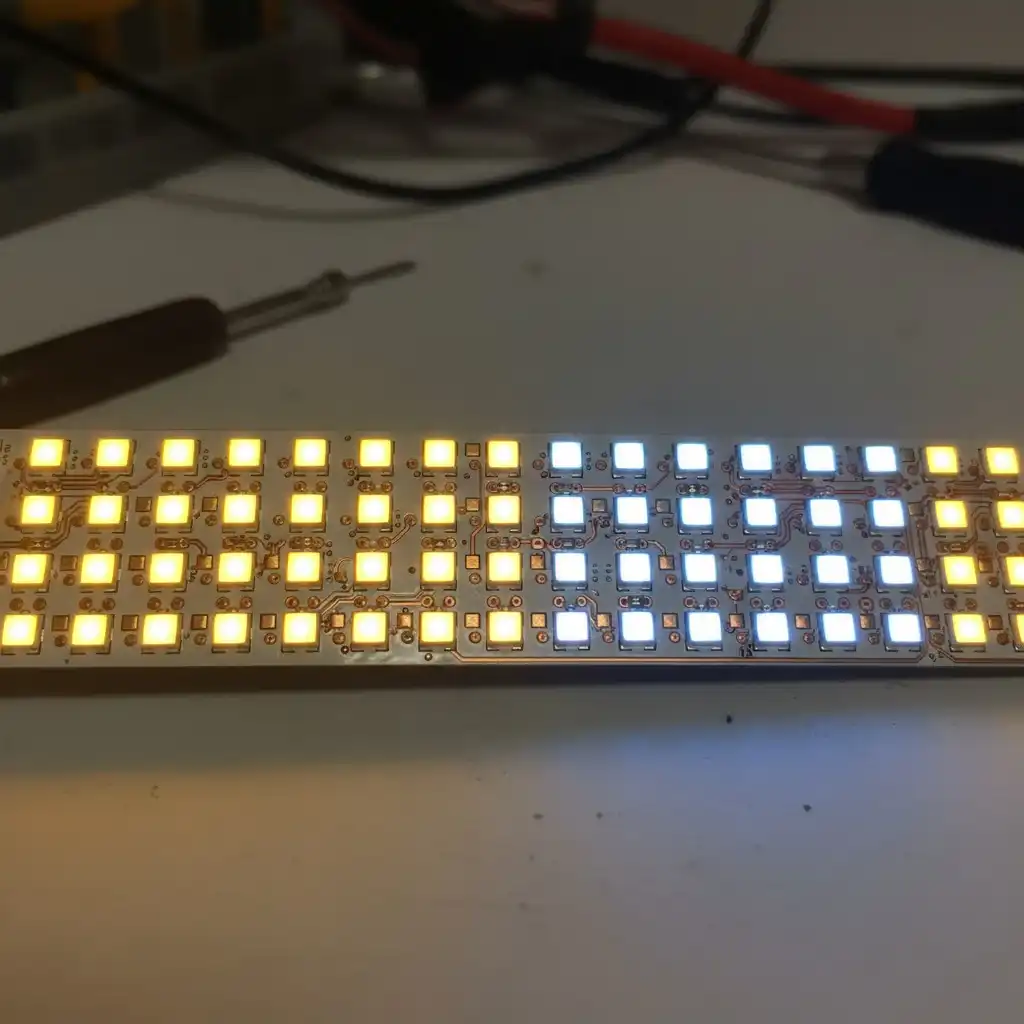
Struggling to create the perfect ambiance for different times of day? CCT changing technology1 gives you full control over your lighting, transforming any space from productive to relaxed instantly.
CCT changing LED lighting works by using a fixture with two sets of LED chips: one warm white and one cool white. A special driver and controller2 adjust the power sent to each set, blending their outputs to create any color temperature between the two extremes.
Getting the right light is more than just brightness; it's about color. The ability to change the Correlated Color Temperature (CCT) of your lighting is a game-changer for commercial spaces, hospitality, and even homes. It allows a single fixture to adapt to different needs, from energizing cool light for daytime work to cozy warm light for evening relaxation. But how does this technology actually work behind the scenes? Let's break down the components, from the chips on the board to the controls on the wall. Understanding this will help you choose the right products for your projects and avoid common pitfalls.
All CCT tunable fixtures can dim to zero brightness.False
Some control systems, like 1–10V, only dim to 10% and require a separate relay or switch for a true 'off' state.
CCT stands for 'Correlated Color Temperature' and is measured in Kelvin (K).True
CCT describes the color appearance of a white light source, with lower Kelvin values (e.g., 2700K) being 'warm' and higher values (e.g., 6500K) being 'cool'.
How does tunable white LED actually mix warm and cool chips?
Finding a single light fixture that works for every task is impossible. You need a solution that adapts, but the inner workings of tunable lighting can seem like a complex mystery.
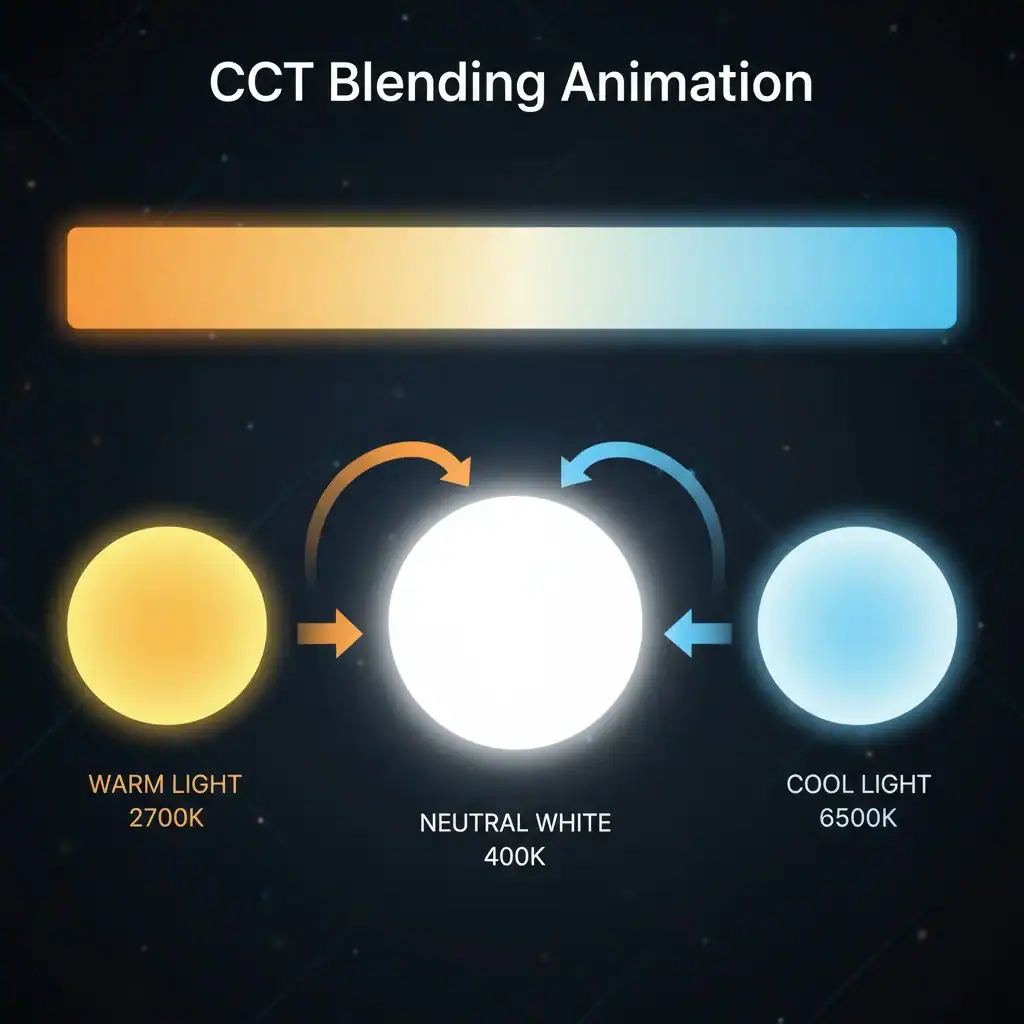
tunable white LEDs3 mix light using two separate channels of LED chips, one warm (e.g., 2700K) and one cool (e.g., 6500K). The driver independently controls the intensity of each channel. By increasing power to one while decreasing it for the other, it blends the light to produce a specific CCT.

Think of it like a faucet with hot and cold water taps. You have a source for warm light and a source for cool light. The tunable white driver is the mixer. When you want a neutral white (around 4000K), the driver powers both the warm and cool LED chips almost equally. If you want a very warm, candle-like glow (2700K), the driver sends full power to the warm chips and little to no power to the cool ones. The reverse is true for achieving a crisp, daylight-like cool white (6500K). This precise control is what allows for a smooth transition across the entire CCT range. At Besenled, we ensure our LED strips have high-density, quality chips to make this blending seamless, without any color separation or spotting, which is a common issue with lower-quality products.
The Role of the Driver and Controller
- Driver: The driver is the brain. It receives a signal from the controller and translates it into the correct power levels for the two LED channels.
- Controller: This is the user interface—a wall panel, remote, or app. It sends the command (e.g., "change to 3500K") to the driver.
You can use any standard dimmer for tunable white LEDs.False
Tunable white requires a specific two-channel driver and a compatible controller that can manage both color temperature and intensity, not just a standard single-channel dimmer.
The total light output (lumens) can vary slightly as you change the CCT.True
Maximum lumen output is often achieved when both the warm and cool channels are at or near full power, which typically occurs in the middle of the CCT range.
What’s the difference between dim-to-warm and full CCT tunable?
Your client wants the cozy feel of an incandescent bulb, but also the flexibility of modern LEDs. Choosing the wrong technology can lead to a lighting experience that feels unnatural and disappointing.
dim-to-warm4 mimics traditional bulbs, where the light gets warmer as it dims. Full CCT tunable offers independent control over brightness and color temperature, allowing you to have bright warm light or dim cool light. It provides much greater flexibility for different applications.
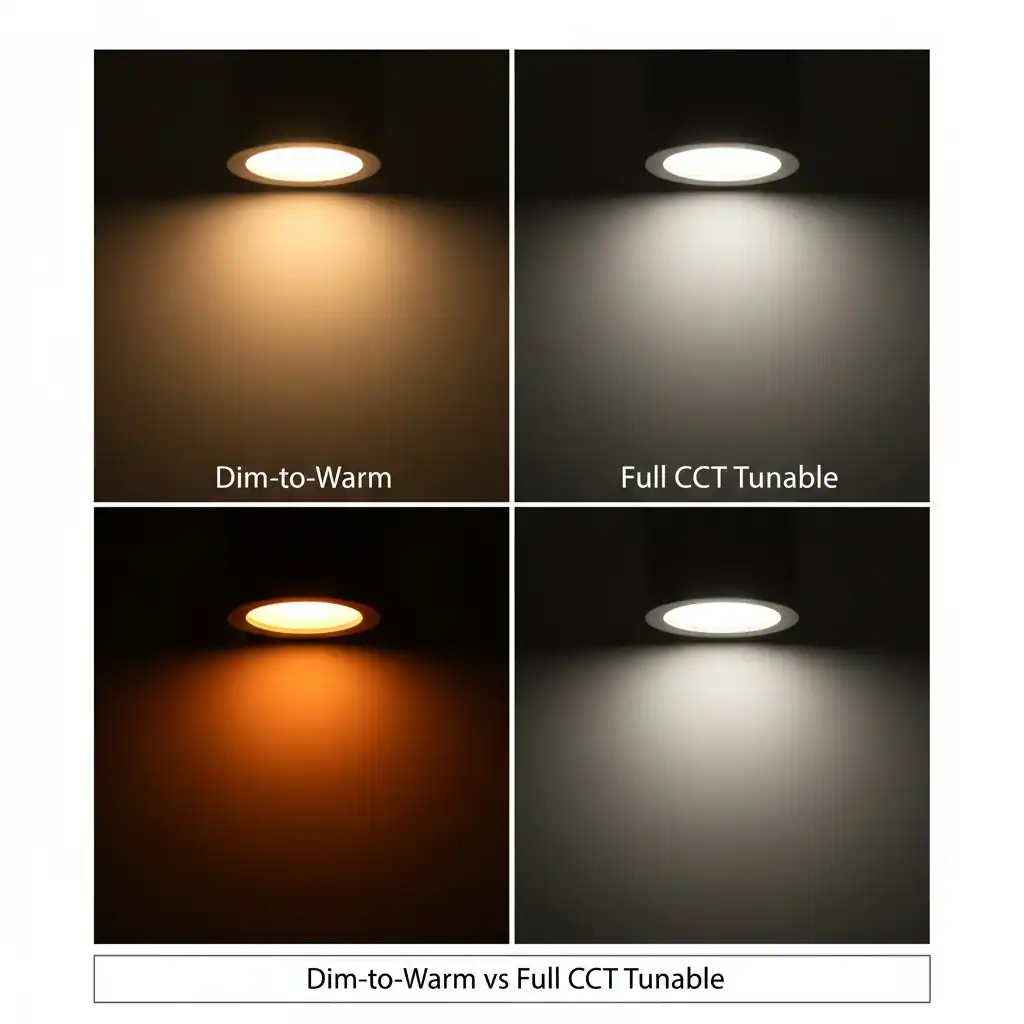
Choosing between these two technologies depends entirely on the project's goal. I often explain it to my clients like this: dim-to-warm is for creating a specific mood, while full CCT tunable5 is for creating a multi-functional space. For a restaurant or a hotel lounge in Mexico, where the goal is a relaxing evening atmosphere, dim-to-warm is perfect. It automatically creates that intimate, sunset glow as you lower the lights. However, for a modern office or a high-end retail store, full CCT tunable is superior. You can set a crisp, energizing 5000K during business hours and then shift to a more welcoming 3000K for an evening event, all without changing the brightness level. Understanding this distinction is key to delivering what your client truly needs, not just what they ask for.
Feature Comparison
| Feature | Dim-to-Warm | Full CCT Tunable |
|---|---|---|
| Function | Color temperature gets warmer as brightness decreases. | Color temperature and brightness are controlled separately. |
| Control | Single channel (standard dimmer). | Two channels (specialized controller). |
| CCT Range | Limited, e.g., 3000K to 1800K. | Wide, e.g., 2700K to 6500K. |
| Best For | Hospitality, residential, creating a cozy ambiance. | Offices, retail, healthcare, multi-purpose spaces. |
Dim-to-warm technology uses a complex algorithm to change color.False
Most dim-to-warm fixtures use a simple circuit with different CCT chips that are activated at different power levels, not a complex algorithm.
Full CCT tunable lighting is a form of human-centric lighting.True
By allowing users to adjust light color to match circadian rhythms or tasks, full CCT tunable lighting supports human health, well-being, and productivity.
Which control protocols are best: 0–10V, DALI, or DMX?
You've selected the perfect tunable fixtures, but now you face a confusing array of control options. Choosing the wrong protocol can result in flickering lights, uneven dimming, and an unhappy client.
For simple CCT tuning, dual-channel 0–10V is a cost-effective solution. For complex projects requiring individual fixture control and feedback, DALI is superior. DMX is the standard for dynamic, color-changing effects and theatrical applications where speed and precision are critical.
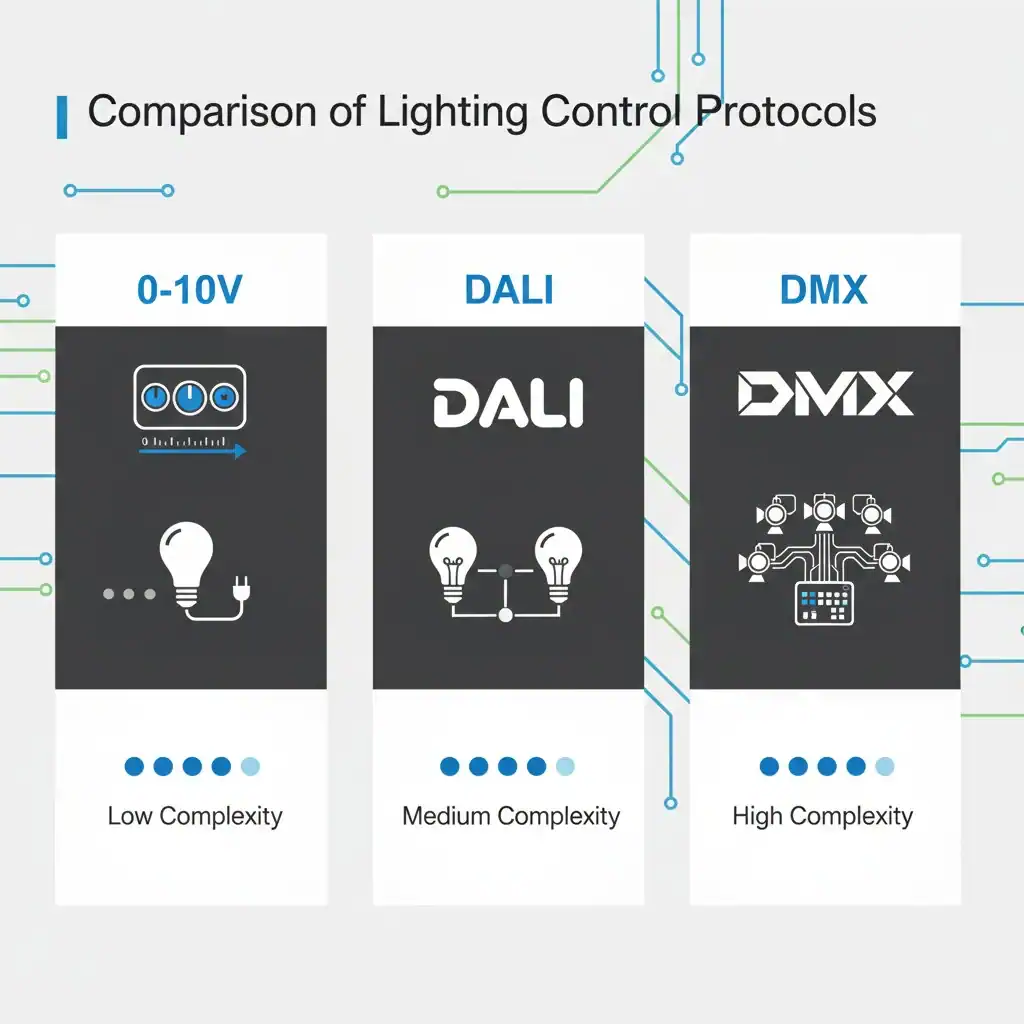
In my 10 years as a factory owner, I've seen control systems cause the most headaches during installation. That's why we give our clients practical advice. For most commercial projects, like an office building or a distributor's warehouse, 0-10V is a reliable workhorse. You use one 0-10V circuit for intensity and a second for color temperature. However, here's a tip from my experience: always use shielded 18-20 AWG control wires and keep them away from AC power lines to prevent interference that causes flicker. For a recent project with a distributor in South America, we recommended DALI because they needed to control zones independently and get status reports from each fixture. It costs more upfront, but it saves a fortune in maintenance and reconfiguration later. DMX is overkill unless you're lighting a stage or a building facade.
Protocol Breakdown
| Protocol | Best For | Pros | Cons |
|---|---|---|---|
| 0–10V | Simple zone control, small to medium projects. | Cost-effective, widely understood, reliable. | Analog, prone to interference, no feedback. |
| DALI | Commercial buildings, smart lighting systems. | Digital, individual addressing, two-way communication. | Higher cost, more complex setup. |
| DMX | Theatrical, architectural, fast color effects. | Very fast, high channel count, industry standard for entertainment. | Complex, requires specialized controllers. |
DALI and 0-10V wiring are interchangeable.False
DALI is a digital, two-wire bus that can be wired without regard to polarity, while 0-10V is an analog system requiring a dedicated pair of wires with correct polarity (+/-) for each channel.
You can group luminaires with different driver types on the same 0-10V circuit.True
While possible, it's bad practice. Grouping luminaires with similar drivers ensures a uniform dimming curve and avoids a 'stepped' look where some lights dim faster than others.
What standards ensure accurate color (CCT, CRI, and chromaticity)?
You've promised your client high-quality, consistent lighting, but the delivered products look different from the samples. This inconsistency can destroy trust and lead to costly replacements and project delays.
Key standards are ANSI C78.3776 for chromaticity, ensuring CCT consistency. The Color Rendering Index (CRI) measures color accuracy, with 90+ being excellent. Duv measures the distance from the black body locus, indicating any green or pink tint.

For my clients, especially distributors like Jose in Mexico who are building their own brand, product quality is everything. A customer won't forgive a batch of lights where 3000K looks different from one fixture to the next. This is where standards become your best defense. We build our products to strict specifications. ANSI C78.377 defines the target CCT and how much it can vary (the MacAdam ellipse). We aim for a tight, 3-step ellipse to guarantee consistency. For CRI, we always recommend 90 or higher for commercial spaces where color appearance matters. Finally, we watch the Duv value7 closely. A positive Duv means a greenish tint, while a negative one is pinkish. Keeping it near zero is crucial for pure white light. As a supplier, providing products that meet these standards, with full test reports and certifications, is how we build long-term trust and protect our clients from risk.
Key Color Quality Metrics
- ANSI C78.377: This American standard defines the color targets for white light LEDs. It uses MacAdam ellipses to specify the tolerance for chromaticity, ensuring that a "3000K" fixture from one batch looks the same as one from another.
- CRI (Color Rendering Index): Measures how accurately a light source reveals the true colors of objects compared to a natural light source. A CRI of 80 is good, but for retail or galleries, 90+ is essential.
- Duv: This value is critical for high-quality white light. It measures the distance of a light source's color point from the black body locus on a chromaticity diagram. A value close to zero ensures a pure white without any undesirable green or pink tints.
A high CRI guarantees good color quality.False
While a high CRI is important, a light can have a high CRI but also a poor Duv value, giving it an unpleasant green or pink tint. Both metrics must be considered.
All LED products sold in Europe must have CE certification.True
The CE mark is a mandatory conformity marking for products sold within the European Economic Area, indicating they meet high safety, health, and environmental protection requirements.
Frequently Asked Questions
How do two LED channels blend to a target CCT?
Controllers compute channel currents from a calibration LUT so spectral mix hits target CCT and keeps total lumen output constant; high-end systems also compensate for driver nonlinearity and thermal drift. DOE overview ↗
Does 0–10V support tunable white without DALI?
Yes, via dual 0–10V inputs or a mixer that translates a single control into two outputs; however, DT8 gives better repeatability and scene recall on large projects. AGC controls ↗ LUXTECH mixer ↗
What data should a vendor provide?
IES files at multiple CCT points, TM‑30 (Rf/Rg), ANSI binning, flicker percent, driver protocol details, and DLC color-tunable reporting where applicable. DLC reporting ↗ ANSI CCT ↗
Is tunable white worth the cost?
Market data indicates strong adoption in commercial/healthcare for productivity and wellness; wireless controls simplify retrofits and cut commissioning costs versus full wired systems. AGC benefits ↗
What are common CCT ranges for tunable white?
2700K–6500K for office/education; hospitality dim-to-warm often 3000K to 1800–2200K. AGC ranges ↗
How do we avoid flicker at low dim levels?
Specify drivers with high PWM frequency or true constant-current analog dimming; request flicker percent and IEEE 1789-aligned claims. DLC references ↗
How do we maintain color consistency across lots?
Require ANSI bin documentation, TM‑30 reporting, and factory calibration; add a commissioning step to fine-tune scenes per space. ANSI CCT ↗
Can wireless tunable white scale to floors?
Yes, with mesh protocols (Zigbee/BLE) plus gateway segmentation and RF surveys; define scenes centrally and lock profiles. Sunricher Zigbee ↗
Conclusion
Understanding CCT changing technology, from chips to controls and standards, empowers you to deliver adaptable, high-quality lighting solutions that meet the precise needs of any commercial or architectural project.
References
Explore how CCT changing technology can enhance your lighting design and create the perfect ambiance. ↩
Discover how drivers and controllers impact the performance and flexibility of LED lighting systems. ↩
Learn about the technology behind tunable white LEDs and their benefits for versatile lighting. ↩
Find out how dim-to-warm technology can create cozy atmospheres in residential and hospitality settings. ↩
Explore the advantages of full CCT tunable lighting for multi-functional spaces and its applications. ↩
Learn about ANSI C78.377 standards and how they ensure color consistency in LED lighting. ↩
Understanding Duv values is key to achieving high-quality white light without unwanted tints. ↩
Topic cluster context
How Does CCT Changing LED Lighting Work?
This guide supports the Smart Commercial Lighting hub. Product, protocol, certification, ranking and performance claims remain subject to the evidence and compatibility checks stated in the article governance record.