
Featured image:

leading paragraph:
Confused by thermocouple charts? Choosing the wrong sensor ruins production batches and wastes money. Here is the simple truth about Type K versus Type J to save your process.
snippet paragraph:
Type K (Nickel-Chromium) is the general-purpose standard for high temperatures (up to 1,260°C) and oxidizing atmospheres1. Type J (Iron-Constantan) is better for lower temperatures (up to 760°C), vacuums, and reducing environments but rusts easily. Choose K for range; choose J for specific atmospheres.
Transition Paragraph:
You might think all temperature sensors are the same. They are not. If you pick the wrong one, your readings will drift, and your product quality will drop. Let me explain the specific details so you can buy the right equipment for your factory.
Generate Claims
Type K thermocouples are made of Nickel-Chromium and Nickel-Aluminum.True
These alloys allow Type K to withstand high temperatures and oxidation.
Type J thermocouples can withstand temperatures up to 1200°C.False
Type J is limited to approximately 760°C because the iron leg oxidizes rapidly above this point.
LOOP START
Choosing Between Type K and J: A 30‑Second Decision Framework?
leading paragraph:
You need a quick answer to keep the production line moving. Hesitation causes delays. Here is how to decide without reading a textbook.
snippet paragraph:
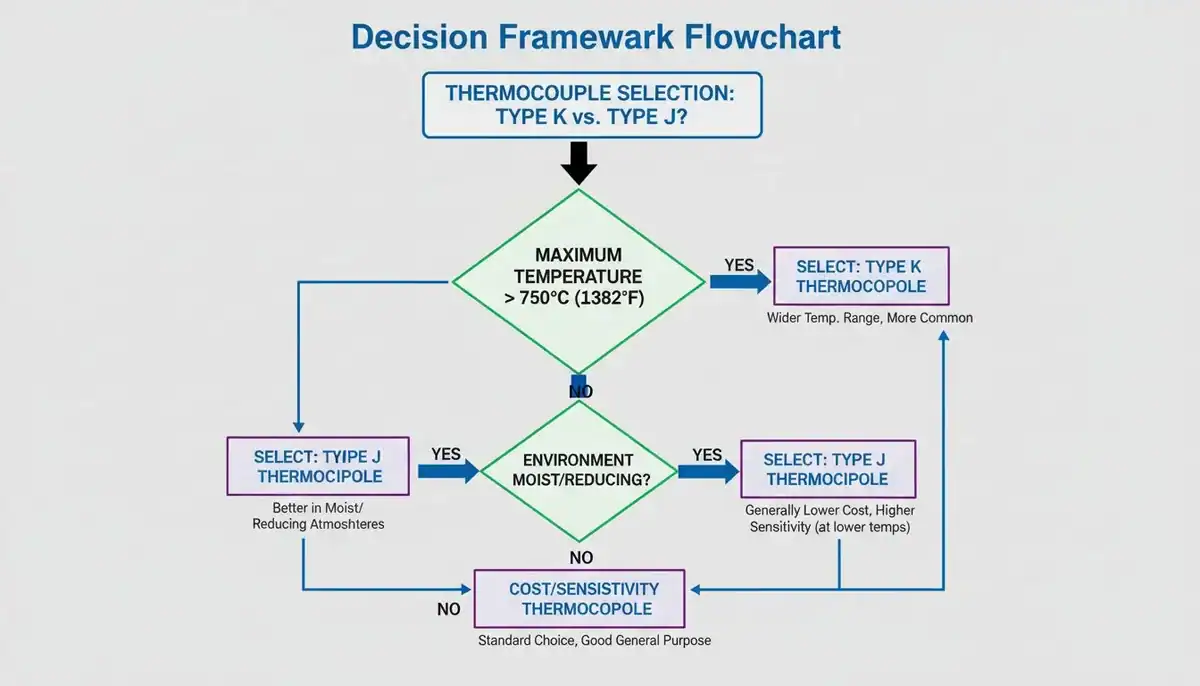
Look at your temperature and environment. If you need over 760°C or have clean air, pick Type K. If you have a vacuum, reducing gas, or lower heat, pick Type J. It is that simple.
Dive deeper Paragraph:
In my factory, time is money. We cannot waste hours debating sensor types. You need a system. Type K is the "workhorse" of the industry. It is the most common sensor because it covers a huge range. It works from -200°C up to 1,260°C. If you are unsure what the atmosphere is, Type K is usually the safer bet. It resists oxidation well.
However, Type J is the "specialist." It has a smaller range, usually 0°C to 750°C. But within that range, it is very stable. It is also cheaper to make because it uses iron. But you must be careful. If you use Type J in a damp place, the iron leg will rust. If you use it too hot, it breaks.
Here is a simple table to help you decide:
| Feature | Type K (Chromel-Alumel) | Type J (Iron-Constantan) |
|---|---|---|
| Top Heat | High (~1,260°C) | Medium (~760°C) |
| Best Air | Clean, Oxidizing | Vacuum, Reducing |
| Weakness | Sulfur, Vacuum | Rust, High Heat |
| Cost | Low | Low |
If you are molding plastics or doing general heat treating, Type J is often fine. For metal processing or high-heat kilns, you must use Type K.
Generate Claims
Type K is the most common general-purpose thermocouple.True
Its wide temperature range and oxidation resistance make it the industry standard.
Type J is more expensive than Type K.False
Type J is typically less expensive because it uses iron, which is cheaper than nickel alloys.
LOOP END
LOOP START
Atmosphere Matters: Oxidizing, Reducing, Vacuum—Which Type Survives?
leading paragraph:
Rust and chemical reactions destroy sensors silently. This leads to bad data and rejected products. You must match the metal to the air inside your machine.
snippet paragraph:
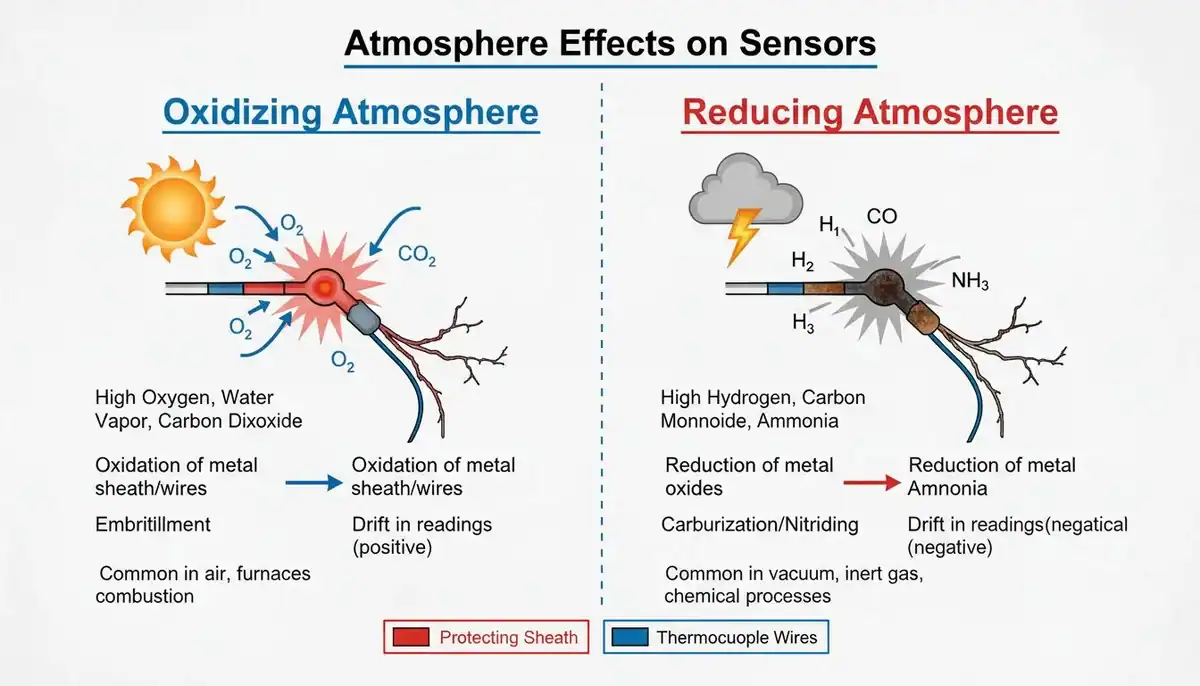
Type K loves oxygen. It works best in clean, oxidizing air. It fails in vacuums. Type J uses iron. It survives where oxygen is low (reducing/vacuum) but rusts instantly if moisture and heat mix in open air.
Dive deeper Paragraph:
The "atmosphere" is just the gas surrounding the sensor. This is where many buyers make mistakes. They look at the temperature but ignore the gas.
Type K relies on a thin layer of oxide to protect itself. This means it needs oxygen to stay healthy. If you put Type K in a vacuum or a "reducing" atmosphere (where oxygen is removed), it fails. The chromium in the wire starts to migrate. We call this "Green Rot." When this happens, the voltage changes. Your sensor might say the oven is 1000°C, but it is actually 900°C. This ruins your product quality.
Type J is the opposite. One leg is made of Iron. Iron loves to rust in normal air. But in a vacuum or a reducing atmosphere, there is no oxygen to cause rust. So, Type J is the king of vacuums. It is also good for old heat-treating furnaces that use gas to remove oxygen.
Also, watch out for sulfur. If your process has sulfur (like in some rubber or oil production), Type K will be destroyed quickly. The sulfur attacks the nickel. In that specific case, you might need a different type entirely, or heavy protection.
Generate Claims
Type K thermocouples are suitable for vacuum applications.False
In a vacuum, chromium vaporizes from the positive leg, causing calibration drift.
Type J is ideal for reducing atmospheres.True
The iron and constantan elements are stable in environments with low oxygen.
LOOP END
LOOP START
Accuracy and Drift: What Standards Allow—and What Real Plants Experience?
leading paragraph:
You pay for precision. But sensors lose accuracy over time, hurting your product quality. You need to know the real limits, not just the sales pitch.
snippet paragraph:
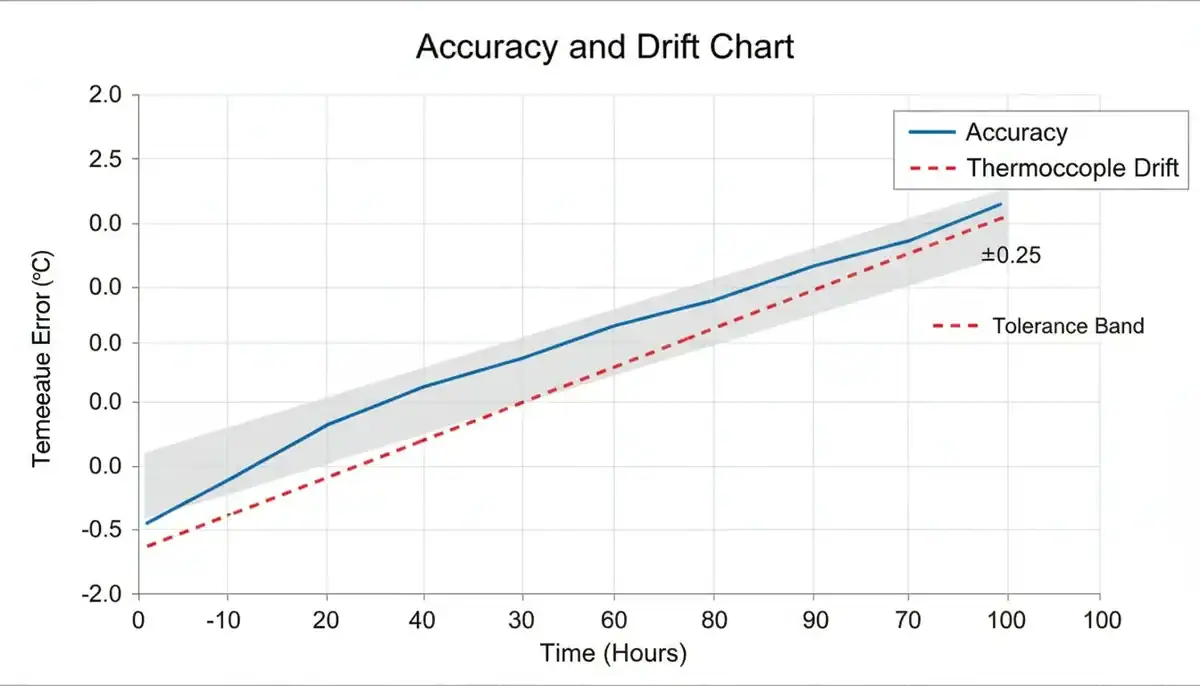
Both follow ANSI/ASTM E230 standards. Standard limits are roughly ±2.2°C. However, Type K drifts more at high heat due to aging. Type J is often more stable at lower temperatures because the iron leg changes less.
Dive deeper Paragraph:
In my business, I deal with certifications like CE and RoHS constantly. I know that a certificate is only a starting point. The real world is different.
Standard Limits of Error2 (SLE) for both Type K and Type J are similar.
- Standard: ±2.2°C or ±0.75% (whichever is greater).
- Special Limits: ±1.1°C or ±0.4%.
If you buy a "Special Limits" wire, it is more accurate. But accuracy is not permanent. This is called "Drift."
Type K is famous for drifting at high temperatures. If you run it at 1000°C for a long time, the metal structure changes. It ages. The reading will slowly move away from the truth. You might not notice it until a client complains about a bad batch.
Type J drifts less, but only if you stay below 760°C. The iron is very stable at lower heats. This is why old plastic injection machines love Type J. It gives a steady reading for years. But if you spike the heat too high, the iron changes permanently, and the sensor is dead.
My advice: If accuracy is critical, replace your sensors regularly. Do not wait for them to break.
Generate Claims
Standard Limits of Error for Type K and J are approximately ±2.2°C.True
This is the standard tolerance defined by ANSI/ASTM E230.
Type K never drifts at high temperatures.False
Type K is susceptible to aging and drift when exposed to prolonged high temperatures.
LOOP END
LOOP START
Build It Right: Junction Type, Sheath Alloy, and Probe Geometry That Prevents Failure?
leading paragraph:
A good sensor inside a bad shell will break. Physical damage stops your machine. You must choose the right armor for your sensor wires.
snippet paragraph:
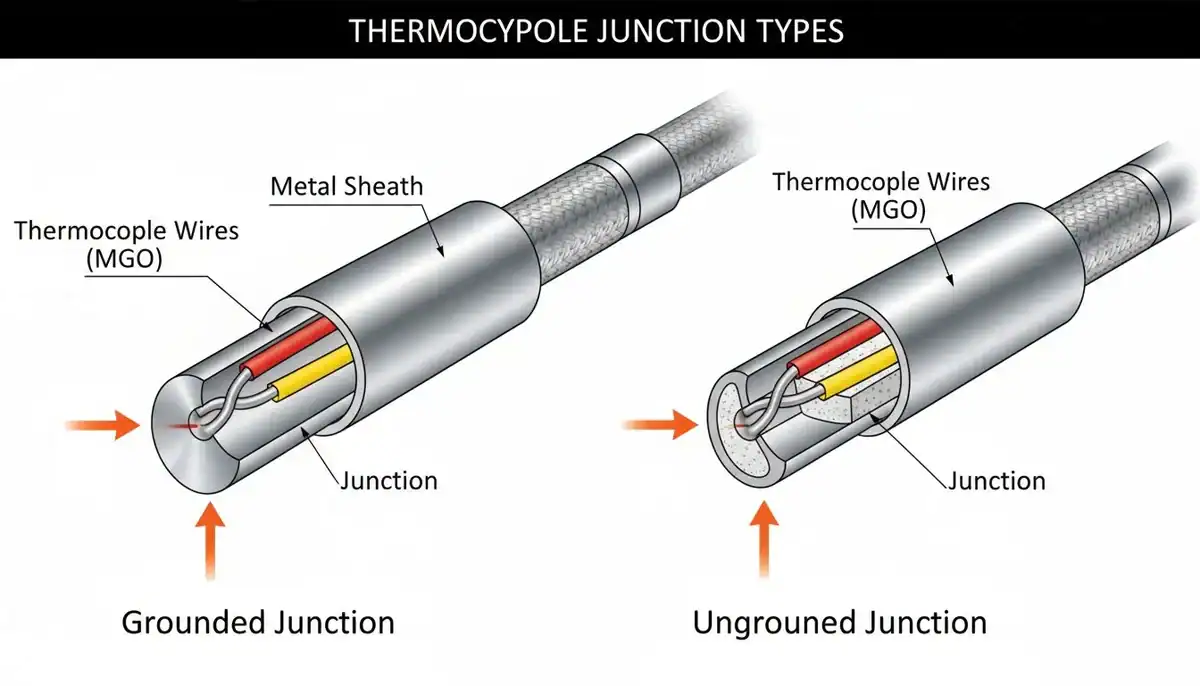
The wire is not enough. You need the right protection. Inconel sheaths protect Type K at high heat. Stainless steel works for Type J. Grounded junctions3 are fast; ungrounded junctions stop electrical noise.
Dive deeper Paragraph:
The sensor wire is delicate. We put it inside a metal tube called a "sheath" to protect it. The material of this tube matters as much as the sensor itself.
For Type K, we usually use Inconel 6004. This is a super-alloy. It handles heat up to 1,150°C without melting or bending. If you put Type K inside a cheap stainless steel tube, the tube will melt before the sensor fails.
For Type J, 304 Stainless Steel is the standard. Since Type J only goes to 760°C, stainless steel is strong enough and cheap. It resists rust on the outside.
You also have to pick the "Junction." This is how the wires touch at the tip.
- Grounded: The wires touch the metal sheath. This is fast. Heat transfers quickly. But, if your machine has electrical noise, it will mess up the signal.
- Ungrounded: The wires float in powder inside the tip. It is slower to react. But it is electrically isolated. This is safer for sensitive electronics.
- Exposed: The wires stick out. It is instant. But gas and dirt will destroy it fast. Only use this for air measurements.
Generate Claims
Inconel 600 is a common sheath material for Type K.True
It withstands the high temperatures that Type K is designed to measure.
Exposed junctions are the most durable type.False
Exposed junctions are vulnerable to physical damage and corrosion, making them the least durable.
LOOP END
LOOP START
FAQ: What are the most common questions about Type K and J?
leading paragraph:
You still have specific questions. Here are the direct answers to clear up any confusion. I want you to feel 100% sure before you order.
snippet paragraph:
We cover temperature ranges, color codes5, and specific failure points. This quick list solves the remaining mysteries so you can order with total confidence.

Dive deeper Paragraph:
Here are the answers to the questions I hear most often from buyers like you.
What is the temperature range6 of Type K vs Type J?
Type K works from roughly -200°C to 1,260°C. Type J works from 0°C to 760°C. Type K wins on range.
Which is more accurate, Type K or J?
They are technically the same. Both have standard limits of ±2.2°C. However, Type J is often more stable and repeatable at lower temperatures (below 500°C).
Which thermocouple is better for vacuum or reducing atmospheres?
Type J is the winner here. Type K needs oxygen. Type J works well without it.
Why does Type K drift at high temperatures?
The alloys in Type K change physically over time when hot. The chromium can also migrate if the air mix is wrong. This changes the voltage output.
What junction type should I choose?
If you need speed, choose Grounded. If you have electrical noise or sensitive controls, choose Ungrounded.
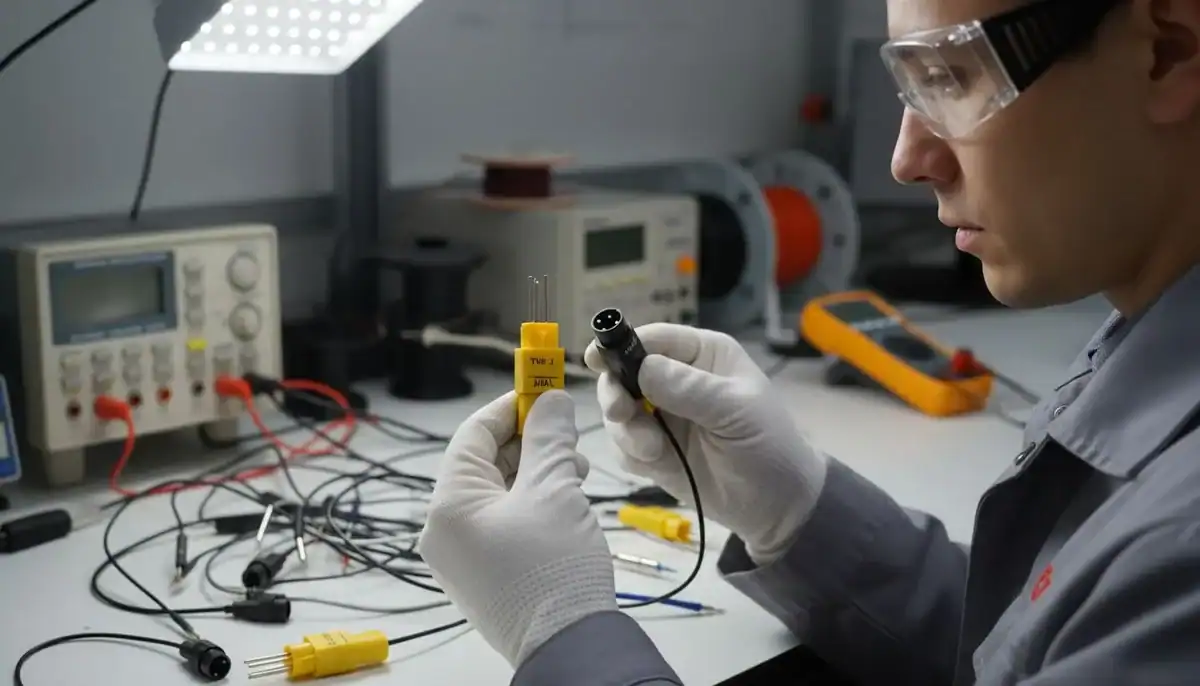
How do color codes identify J and K?
In the ANSI (USA) standard:
- Type K: Yellow connector, Yellow outer wire, Red (-) and Yellow (+) inner wires.
- Type J: Black connector, Black outer wire, Red (-) and White (+) inner wires.
- Note: Other countries like Germany (DIN) or Japan (JIS) use different colors. Always check the plug.
Generate Claims
Type K connectors are typically yellow in ANSI standards.True
Yellow is the standard color code for Type K in North America.
Type J is better for high-temperature oxidizing atmospheres.False
Type J oxidizes rapidly at high temperatures; Type K is better for this.
LOOP END
Conclusion
Type K handles high heat and air. Type J handles vacuums and lower heat. Choose wisely to protect your production quality. Contact Besenled for reliable manufacturing advice.
References
- Understand the significance of oxidizing atmospheres and how they affect thermocouple performance. ↩
- Learn about the accuracy standards for thermocouples and how they affect measurement reliability. ↩
- Understand the advantages and disadvantages of grounded junctions for thermocouple applications. ↩
- Explore the properties of Inconel 600 and why it's a preferred sheath material for high-temperature thermocouples. ↩
- Learn about the ANSI color codes for thermocouples to ensure correct identification and usage. ↩
- Find out the temperature limits for Type K and Type J thermocouples to make informed choices. ↩